

High Frequency Galvanic Facial Safety Contraindications — Guide
high frequency galvanic facial safety contraindications: Practical guidance on high frequency galvanic facial safety contraindications, screening steps, and al…

View article sections
- 01Table of contents
- 02Quick summary: why this matters now
- 03What are the devices and how they’re used
- 04Confirmed facts from official guidance (what the board and manuals say)
- 05Common contraindications to screen for
- 06How Asal Skin Lounge screens clients (practical workflow)
- 07Device limits, training, and documentation
- 08Comparison: High-frequency vs Galvanic vs LED (safety and contraindications)
- 09Practical examples and red flags
- 10Legal and scope-of-practice considerations
- 11When to consult or refer
- 12Alternatives and add-on substitutions at Asal Skin Lounge
- 13Costs and availability
- 14Limitations and what we estimate but can’t promise
- 15How to prepare for an appointment
- 16Summary checklist for estheticians (one-page)
- 17Next steps for Woodland Hills clients
- 18Frequently asked questions
Estimated reading time: 9 minute read
Table of contents
- Quick summary: why this matters now
- What are the devices and how they’re used
- Key point (opening): high frequency galvanic facial safety contraindications
- Confirmed facts from official guidance (what the board and manuals say)
- Common contraindications to screen for
- How Asal Skin Lounge screens clients (practical workflow)
- Device limits, training, and documentation
- Comparison: High-frequency vs Galvanic vs LED (safety and contraindications)
- Practical examples and red flags
- Legal and scope-of-practice considerations
- When to consult or refer
- Alternatives and add-on substitutions at Asal Skin Lounge
- Costs and availability
- Limitations and what we estimate but can’t promise
- How to prepare for an appointment
- Summary checklist for estheticians (one-page)
- Labeling of source types used in this guide
- Next steps for Woodland Hills clients
- Frequently asked questions
- Can pregnant clients ever receive high-frequency or galvanic add-ons?
- Are pacemakers an automatic disqualifier?
- What if I have a small metal dental implant or filling?
- How long after laser or chemical peel should I wait before getting galvanic or high-frequency?
- Who should I contact if I’m unsure about a medical condition?
- Related guides and resources
- Frequently asked questions
- Can pregnant clients ever receive high-frequency or galvanic add-ons?
- Are pacemakers an automatic disqualifier for electrical facials?
- How should I disclose a recent cosmetic procedure before booking?
- What safe alternatives are available if I can’t have a high-frequency or galvanic add-on?
- Who sets the official safety rules for estheticians in California?
- Need practical help?
- Topic in context
- Sources and further reading
Updated 2026-09-28: New-client questions about pregnancy, pacemakers, broken skin, and electrical facial add-ons prompted this guidance. This article explains what changed and why it matters to Woodland Hills clients and estheticians.
On 2026-09-28 we reviewed current California practice guidance and manufacturer manuals to reduce treatment risk and clarify screening expectations. It is important for clients to understand device-specific warnings and the common reasons an esthetician will decline a high-frequency or galvanic add-on during a facial.
high frequency galvanic facial safety contraindications is the focus of this dated, source-based update. As a result, the article separates verified details from analysis.
Quick summary: why this matters now
Clients commonly ask whether electrical add-ons are safe during pregnancy or with a pacemaker. Because the California Board of Barbering and Cosmetology bulletin and device manuals highlight overlapping but distinct restrictions, estheticians should use both sources when screening clients [1][2]. As of 2026-09-28, confirmed facts from official guidance affect booking choices, informed-consent conversations, and liability-reduction steps.
What are the devices and how they’re used
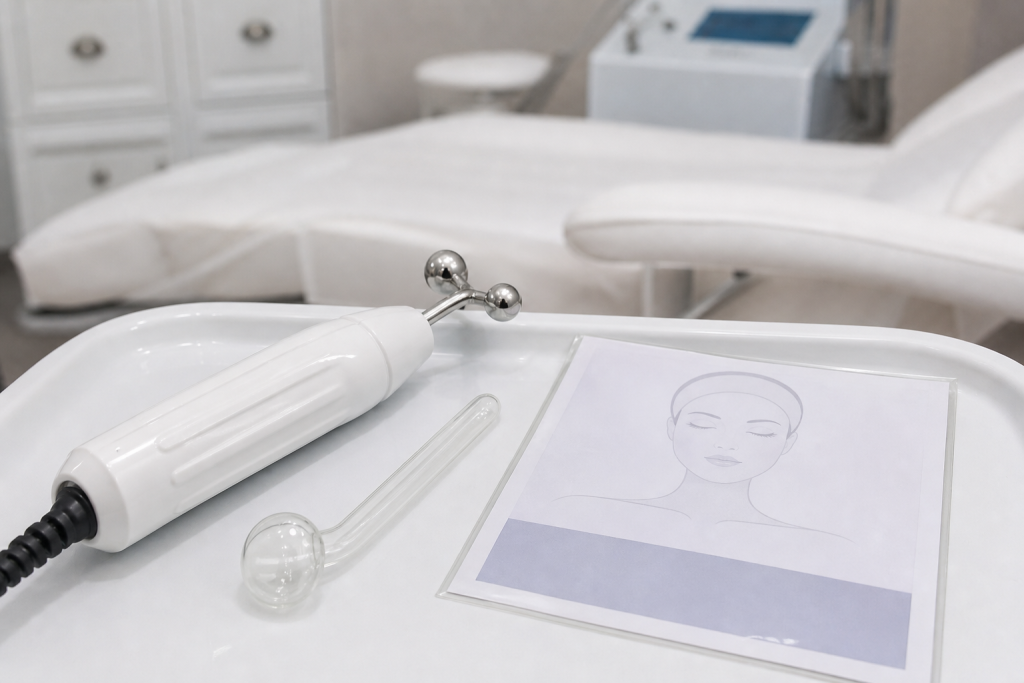
High-frequency and galvanic devices are professional facial add-ons used for circulation, mild antiseptic effects, and to assist topical product delivery. High-frequency uses a glass electrode and a small alternating current at high frequency. Galvanic devices apply a direct current to create desincrustation or iontophoresis for deeper product infusion. Both are commonly offered as add-ons at studios like Asal Skin Lounge.
Key point (opening): high frequency galvanic facial safety contraindications
When screening clients, estheticians should explicitly ask about implanted electronic devices, pregnancy, recent cosmetic procedures, metal implants near the treatment site, active infection or open wounds, and certain medications. These screening topics are central because they connect directly to the high frequency galvanic facial safety contraindications emphasized in regulatory and manufacturer guidance [1][2][3].
Confirmed facts from official guidance (what the board and manuals say)
- California Board guidance requires estheticians to follow manufacturer instructions and to avoid electrical modalities for clients with implanted electronic devices, including pacemakers and defibrillators [1]. (Confirmed fact; official bulletin.)
- Manufacturer manuals for galvanic units typically list pregnancy, implanted electrical devices, epilepsy, and open wounds as contraindications; they also set device-specific current limits and usage timing [2]. (Confirmed fact; manufacturer safety warnings.)
- State exam and practice Q&A resources reiterate that estheticians must screen clients and refuse or modify services when electrical modalities pose a known risk [3]. (Independent reporting of scope guidance.)
Common contraindications to screen for
Below are the most frequent reasons an esthetician will decline or modify a high-frequency or galvanic add-on. These items reflect combined guidance from the California Board and manufacturer manuals. Always verify device-specific instructions before use.
- Implanted electronic devices: pacemakers, ICDs, deep brain stimulators. Direct or nearby application may interfere with device function [1][2].
- Pregnancy: Many manufacturers list pregnancy as a contraindication for galvanic and high-frequency treatments; therefore estheticians usually avoid these modalities during pregnancy [2].
- Active infection, open wounds, or broken skin: Electrical current over open lesions can increase irritation or spread microbes; avoid treatment until healed [1][2].
- Recent cosmetic procedures: recent chemical peels, laser, dermabrasion, or filler injections require a healing interval; check device instructions and practitioner recommendations [1].
- Epilepsy or seizure disorders: Some manuals advise against high-frequency use in clients with seizure history [2].
- Metal implants near treatment site: Metal can conduct current unexpectedly; device manuals recommend caution or exclusion [2].
- Certain medications or topical agents: Photosensitizing or irritant medications may increase risk; review client medications during intake [1].
- Sensitivity and unstable cardiovascular conditions: Use clinical judgment and consult medical providers when in doubt [1].
How Asal Skin Lounge screens clients (practical workflow)
Asal Skin Lounge uses a screening checklist that mirrors board and manufacturer guidance. In practice, estheticians ask about implants, pregnancy, recent procedures, seizures, medications, and skin integrity before scheduling or adding high-frequency or galvanic services. If a contraindication is present, we pause the add-on and discuss alternatives.
For example, if a client reports a pacemaker, we will not apply high-frequency or galvanic current near the device. Instead, we may offer manual lymphatic massage, LED therapy, or a hydrating mask. These alternatives avoid electrical current but still support the facial goals.
Device limits, training, and documentation
Manufacturer manuals specify safe current ranges, electrode placement, and session durations; estheticians must follow those instructions to stay within the device’s tested parameters [2]. Moreover, the California Board bulletin stresses that practitioners must be trained on specific machines and should keep manufacturer instructions and maintenance logs accessible [1]. (Confirmed facts.)
Comparison: High-frequency vs Galvanic vs LED (safety and contraindications)
| Dimension | High-frequency | Galvanic | LED |
|---|---|---|---|
| Primary action | Alternating high-frequency current; antiseptic and circulation effects | Direct current; desincrustation and iontophoresis for product delivery | Phototherapy using specific wavelengths; non-electrical |
| Common contraindications | Pacemakers, pregnancy (manufacturer-dependent), seizure disorders, open wounds [2] | Pacemakers, pregnancy (commonly listed), metal implants near site, open wounds [2] | Photosensitivity, certain medications; generally safer for implants and pregnancy but check specifics |
| Documentation | Follow device manual for electrode use and duration [2] | Follow device manual for polarity, current limits, and timing [2] | Follow LED device instructions; screen for photosensitizers |
| Typical alternatives if contraindicated | LED, manual therapies, masks | LED, product-focused treatments without current | Manual exfoliation, hydrating treatments |
Practical examples and red flags
- If a client is pregnant and requests iontophoresis, estheticians should decline the galvanic add-on and offer non-electrical penetration methods instead. This follows manufacturer and regulatory caution [2][1].
- If a client has a pacemaker, estheticians should avoid high-frequency probes near the chest or jawline; instead, choose alternatives that carry no electrical current [1].
- If a client recently had a medium or deep chemical peel, delay electrical modalities until the treated skin fully heals. Manufacturer guidance often requires a waiting period [2].
Legal and scope-of-practice considerations
The California Board bulletin underscores that estheticians must not use devices in ways that exceed training or manufacturer recommendations. Estheticians should keep written consent, intake forms, and device manuals on file. Failure to follow these rules may expose a salon to enforcement action [1]. (Official announcement; confirmed.)
When to consult or refer
If a potential contraindication is unclear, estheticians should request written clearance from a client’s medical provider. For example, clients with complex cardiac histories or implantable devices should get physician clearance before any electrical modality is used [1][3].
Alternatives and add-on substitutions at Asal Skin Lounge
When high-frequency or galvanic services are contraindicated, Asal Skin Lounge offers effective alternatives: LED light therapy, manual lymphatic and facial massage, hydrating and antioxidant serums, and customized masks. These options help meet treatment goals while staying within safety limits.
Costs and availability
Availability of add-ons depends on device access and staff training. Pricing varies by service. Please inquire when booking so we can confirm trained availability and appropriate screening steps.
Limitations and what we estimate but can’t promise
Manufacturer manuals and board guidance reduce risk but cannot eliminate it entirely. We estimate that following these procedures lowers the chance of adverse events, however individual outcomes vary. This article does not replace individualized medical advice.
How to prepare for an appointment
- Complete the intake form honestly—disclose implants, pregnancy, recent procedures, and medications.
- List the exact area you want treated and note any metal implants or dental appliances.
- Expect to be offered a safe alternative if a screening item is flagged.
Summary checklist for estheticians (one-page)
- Confirm device manual and operating limits before use [2].
- Screen clients for implants, pregnancy, wounds, seizures, and recent procedures [1][3].
- Document informed consent and any medical clearances [1].
- Offer non-electrical alternatives when contraindicated.
Labeling of source types used in this guide
Confirmed facts: California Board bulletin and device manuals [1][2]. Official announcements: California Board recommendations in an industry bulletin [1]. Independent reporting/analysis: PrepPass practice Q&A summarizing state exam topics and scope issues [3]. All materials were reviewed as of 2026-09-28.
Next steps for Woodland Hills clients
If you’re booking a facial at Asal Skin Lounge in Woodland Hills, expect a short screening during booking or check-in. For safety and quality, we follow the California Board of Barbering and Cosmetology guidance and device manuals when offering high-frequency or galvanic add-ons [1][2].
To schedule, book online or call us at +1 (747) 746-3818. We will review your intake, confirm trained staff availability, and recommend safe alternatives if needed.
Frequently asked questions
Can pregnant clients ever receive high-frequency or galvanic add-ons?
Most manufacturers list pregnancy as a contraindication for galvanic and sometimes high-frequency devices; therefore pregnant clients are usually advised to avoid these add-ons. Alternatives like LED or manual treatments are typically offered instead [2].
Are pacemakers an automatic disqualifier?
Yes. Implanted electronic devices such as pacemakers are typically listed as contraindications because electrical currents can interfere with device function. Estheticians should not apply current near implanted devices [1][2].
What if I have a small metal dental implant or filling?
Small dental fillings or isolated dental implants are common. The risk depends on device placement and manufacturer guidance. Disclose these at intake so the esthetician can avoid direct placement and choose safer options [2].
How long after laser or chemical peel should I wait before getting galvanic or high-frequency?
Wait until the skin barrier has fully healed. Manufacturer manuals and clinical judgment determine the exact interval; when in doubt, obtain written clearance from the practitioner who performed the procedure [2][1].
Who should I contact if I’m unsure about a medical condition?
If you have complex medical concerns, ask your medical provider for written clearance. Our estheticians can also consult the device manual and the California Board guidance for additional clarity [1][2].


Frequently asked questions
Can pregnant clients ever receive high-frequency or galvanic add-ons?
Most manufacturers list pregnancy as a contraindication for galvanic devices and often for high-frequency devices. Therefore, estheticians usually avoid these add-ons during pregnancy and offer alternatives such as LED or manual therapies [2].
Are pacemakers an automatic disqualifier for electrical facials?
Yes. Implanted electronic devices like pacemakers and defibrillators are commonly listed as contraindications because electrical currents can interfere with device function. Estheticians should not apply electrical modalities near implanted devices [1][2].
How should I disclose a recent cosmetic procedure before booking?
Disclose any recent laser, chemical peel, or filler treatments on your intake form. Estheticians will verify healing and may require a waiting period or medical clearance before using high-frequency or galvanic devices [1][2].
What safe alternatives are available if I can’t have a high-frequency or galvanic add-on?
Common alternatives include LED light therapy, manual facial and lymphatic massage, hydrating masks, and topical serums. These options avoid electrical current while addressing hydration, circulation, and relaxation goals.
Who sets the official safety rules for estheticians in California?
The California Board of Barbering and Cosmetology issues industry guidance on devices and scope-of-practice issues. Estheticians must also follow device manufacturer manuals and obtain training on specific machines [1].
Need practical help?
Asal Skin Lounge — Contact us to schedule service or request a quote. Service area: Woodland Hills.
Topic in context
Sources and further reading
These links were validated and checked when possible when this article was created; some publishers limit automated requests. Facts, guidance, prices, regulations, and availability can change.
- Industry Bulletin – Skin Care Machines/Devices (electrical modalities guidance) — California Board of Barbering and Cosmetology (2023-08-07) — primary source
- Galvanic Facial Skincare Unit — Product Manual (safety & contraindications) — Skin+ACT (manufacturer manual) — primary source
- California Esthetician Practice Q&A (electrical modalities, contraindications) — PrepPass (state exam / scope references)