
LED light therapy facial add-on safety Woodland Hills Guide
LED light therapy facial add-on safety Woodland Hills: Updated safety guidance and local practical advice on LED light therapy facial add-on safety Woodland Hi…
View article sections
- 01Table of contents
- 02LED light therapy facial add-on safety Woodland Hills
- 03What changed on 2026-08-31 and why it matters to Woodland Hills clients
- 04Opening snapshot: what clients should know now
- 05How LED add-ons are used in professional facials
- 06Key safety considerations for Woodland Hills clients
- 07Comparing professional LED add-ons, at‑home devices, and alternative add-ons
- 08Practical next steps before booking at Asal Skin Lounge (Woodland Hills)
- 09When LED add-ons make sense and realistic expectations
- 10Labeling confirmed, independent, and analytical statements
- 11How Asal Skin Lounge implements safety for LED add-ons (Woodland Hills)
- 12Book or call
- 13Frequently asked questions
- 14Related guides and resources
- 15Frequently asked questions
- 16Need practical help?
- 17Topic in context
- 18Sources and further reading
Quick summary: This update summarizes verified safety guidance for LED light therapy add-ons to professional facials in Woodland Hills, emphasizing device selection, pre-treatment screening, and realistic expectations. It highlights contraindications (photosensitizing meds, recent aggressive resurfacing, pregnancy, seizure history) and practical booking steps at Asal Skin Lounge.
Estimated reading time: 10 minute read
Table of contents
- LED light therapy facial add-on safety Woodland Hills
- What changed on 2026-08-31 and why it matters to Woodland Hills clients
- Opening snapshot: what clients should know now
- Confirmed facts and official announcements
- How LED add-ons are used in professional facials
- What the evidence and guidance say about benefits
- Key safety considerations for Woodland Hills clients
- Who should consider skipping LED add-ons (analysis)
- Comparing professional LED add-ons, at‑home devices, and alternative add-ons
- Practical next steps before booking at Asal Skin Lounge (Woodland Hills)
- Cost and availability (estimate)
- When LED add-ons make sense and realistic expectations
- Alternatives if LED is not appropriate
- Labeling confirmed, independent, and analytical statements
- How Asal Skin Lounge implements safety for LED add-ons (Woodland Hills)
- Final practical advice
- Book or call
- Frequently asked questions
- 1. Is LED light therapy safe after extractions or chemical exfoliation?
- 2. Can I get LED treatment if I take antibiotics or topical retinoids?
- 3. How many LED add-on sessions do I need to see a difference?
- 4. Are at‑home LED devices as safe and effective as professional devices?
- 5. What should I ask my provider before adding LED to my facial?
- Related guides and resources
- Frequently asked questions
- Is LED light therapy safe after extractions or chemical exfoliation?
- Can I get LED treatment if I take antibiotics or topical retinoids?
- How many LED add-on sessions are typically needed to see improvement?
- Are at-home LED devices as safe and effective as professional LED add-ons?
- What should I tell my provider before booking an LED add-on?
- Need practical help?
- Topic in context
- Sources and further reading
LED light therapy facial add-on safety Woodland Hills
This dated, source-based update separates verified details, limitations, and practical next steps.
What changed on 2026-08-31 and why it matters to Woodland Hills clients
On 2026-08-31, Asal Skin Lounge updated this guidance for local clients because federal and specialty recommendations about photobiomodulation and red/near-infrared devices have evolved, and LED add-ons remain a popular, low‑downtime enhancement for facials. Official draft guidance from the U.S. Food and Drug Administration (FDA) on photobiomodulation (PBM) devices was issued on 2023-06-22; as of 2026-08-31, that guidance remains the primary federal framework for device makers and clinics to consider when evaluating device clearance and labeling [2]. This matters to Woodland Hills clients because the guidance clarifies device classifications, intended uses, and submission expectations that influence how clinicians select and use LED platforms in a spa or medical setting [2].
Opening snapshot: what clients should know now
LED light therapy facial add-on safety Woodland Hills is largely about choosing a properly designed device, understanding contraindications, and expecting supportive—not miraculous—skin benefits. When added to a professional facial, LED can improve post‑treatment comfort and support skin recovery in some concerns, but it is not a substitute for medical care. Independent clinical overviews list potential benefits, color uses, and common risks; major professional bodies emphasize device selection, eye protection, and attention to photosensitivity from medications or conditions [1][3].
Confirmed facts and official announcements
- FDA released draft guidance for PBM device premarket submissions on 2023-06-22; this is an official federal guidance document for manufacturers and clinicians to follow when assessing device claims and safety as of 2026-08-31 [2].
- Medical organizations and hospital systems provide independent reviews of LED uses, typical wavelengths, and safety considerations; these include summaries from sources such as the Cleveland Clinic and the American Academy of Dermatology (AAD) [1][3].
How LED add-ons are used in professional facials
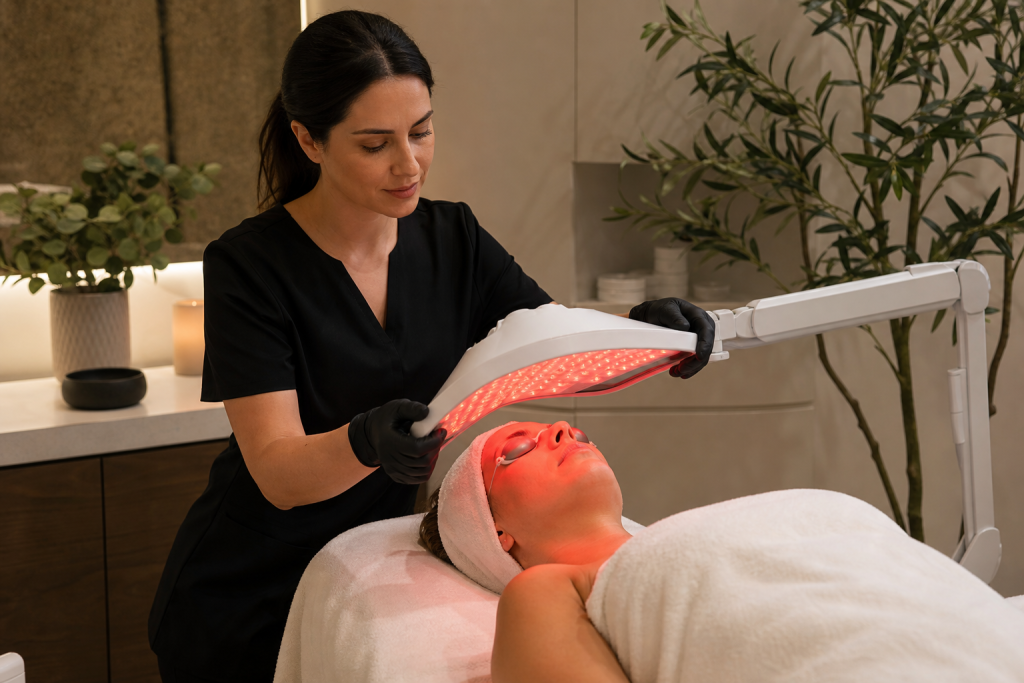
In a professional facial setting, LED light therapy is commonly offered as a short add-on after extraction, microdermabrasion, or chemical exfoliation. The clinician positions a panel or hood over the face for a defined time using red, near-infrared, or blue wavelengths depending on the intended outcome. Typical sessions for facial add-ons last 5–20 minutes and are designed to be low‑heat and noninvasive [1].
What the evidence and guidance say about benefits
Independent clinical overviews describe how different wavelengths interact with skin: red and near‑infrared light penetrate more deeply and are often used to support skin recovery and the appearance of texture, whereas blue light targets bacteria near the surface and is sometimes used for acne-prone skin [1]. However, evidence quality varies and outcomes depend on device power, wavelength, treatment timing, and the underlying skin concern. The FDA guidance focuses on device characteristics and claims rather than promising specific results [2].
Key safety considerations for Woodland Hills clients
LED light therapy facial add-on safety Woodland Hills depends on three practical steps: device selection, client screening, and correct use. First, choose a professional device from a reputable manufacturer that follows FDA guidance for PBM devices or has appropriate clearances for its intended use [2]. Second, complete a pre-treatment screening for photosensitizing medications, active infections, recent chemical peels, pregnancy concerns, seizure history, and eye conditions. Third, use eye protection and follow recommended session durations and distances to the device.
Confirmed risk factors include increased photosensitivity (from medications such as certain antibiotics or isotretinoin), active sunburn, and open wounds—clients with these factors are often advised to delay LED treatments until cleared by a clinician or physician [1][3].
Who should consider skipping LED add-ons (analysis)
- People on photosensitizing prescriptions or topical agents without clearance from their prescribing clinician [3].
- Clients with active inflammatory skin conditions (severe rosacea flare, open wounds, or active infection) until stabilized [1].
- Those with a personal history of light‑triggered seizures should consult a physician before exposure to flashing or pulsed light [3].
- Clients who recently had aggressive resurfacing or chemical peels should wait per the clinician’s timeline to avoid irritation [1].
Comparing professional LED add-ons, at‑home devices, and alternative add-ons
| Feature | Professional LED add-on | At‑home LED devices | Other facial add-ons (high‑freq, galvanic) |
|---|---|---|---|
| Device power & control | Higher power, clinician-set protocols, trained supervision | Lower power, preset cycles, variable quality | Different modality (electrical), supports circulation and product infusion |
| Typical session length | 5–20 minutes per treatment | 10–30 minutes per home session, repeated | 5–15 minutes depending on service |
| Safety oversight | Clinician screening, eye protection | User responsibility, variable instructions | Clinician-controlled; different contraindications |
| Primary uses | Post‑treatment recovery, supportive care for texture or acne | Maintenance, modest improvements with consistent use | Circulation, lymphatic drainage, product penetration |
Practical next steps before booking at Asal Skin Lounge (Woodland Hills)
- Tell us about current medications, recent procedures, and photosensitivity during booking so we can screen appropriately.
- Ask whether the device used in your appointment follows PBM device recommendations and whether it has relevant filings or clearances; device selection affects safety and expected outcomes [2].
- Plan LED as an add-on after extractions or gentle resurfacing; we’ll suggest timing to reduce irritation and improve comfort.
- If you are pregnant, nursing, on photosensitizing medication, or have concerns about seizures or eye disease, consult your physician and inform our team before treatment [1][3].
Cost and availability (estimate)
Costs vary by device and session length. Asal Skin Lounge offers LED add-ons priced competitively with other professional add-ons; availability depends on technician schedules and device capacity. For a precise quote and appointment options in Woodland Hills, contact the studio to confirm current pricing and book a slot.
When LED add-ons make sense and realistic expectations
LED light therapy facial add-on safety Woodland Hills clients should expect modest, supportive improvements—such as reduced immediate redness after exfoliation and a calming sensation—rather than dramatic transformations in one visit. Multiple treatments spaced over weeks are typically required for measurable change, and results depend on treatment type, device parameters, and home care. Independent sources emphasize realistic expectations and point out that device selection, dose, and treatment regimen drive outcomes more than a single session [1][3].
Alternatives if LED is not appropriate
- High‑frequency therapy for short-term bacterial reduction and circulation support.
- Galvanic deep infusion to enhance product penetration after extractions.
- Hydrating or anti‑inflammatory mask add-ons to soothe sensitive, recently treated skin.
Labeling confirmed, independent, and analytical statements
- Official announcement: FDA draft guidance on PBM devices was published 2023-06-22; manufacturers and clinics use this document to inform device claims and safety practices [2].
- Independent clinical reporting: Overviews from sources such as the Cleveland Clinic summarize wavelengths, common clinical uses, and typical safety considerations for LED therapy [1].
- Professional guidance: The AAD provides patient-facing guidance on red light therapy risks, eye protection, and photosensitivity considerations; follow professional screening steps when receiving treatments [3].
- Analysis: At Asal Skin Lounge we interpret these sources to prioritize device quality, clinician screening, and conservative use of LED add-ons to minimize risk and support client comfort.
How Asal Skin Lounge implements safety for LED add-ons (Woodland Hills)
We screen each client for medications, recent procedures, and contraindications; use eye protection during every LED session; and select treatment durations aligned with device guidelines and the client’s skin history. Our staff monitors comfort and documents responses so we can adapt future sessions.
Final practical advice
If you want LED included with your facial, mention it when booking so we can confirm suitability and schedule the right device and timing. If you have a history of photosensitivity, recent aggressive resurfacing, pregnancy, or seizure disorders, tell us in advance so we can recommend safe alternatives or require physician clearance [1][3].
Book or call
For appointments in Woodland Hills, contact Asal Skin Lounge at +1 (747) 746-3818 or book online. Our studio address is 19903 Ventura Blvd #3, Woodland Hills, CA 91364. We’re available to answer screening questions and match the right add-ons to your facial.
Frequently asked questions
1. Is LED light therapy safe after extractions or chemical exfoliation?
Generally, LED is frequently used as a low‑heat, soothing add-on after extractions or gentle chemical exfoliation, but the timing depends on the strength of the peel and your skin sensitivity. If you had an aggressive peel, wait until the clinician clears the area; if you recently used photosensitizing drugs, skip LED until cleared by your prescriber [1][3].
2. Can I get LED treatment if I take antibiotics or topical retinoids?
Some antibiotics and topical agents increase photosensitivity. You should disclose these medications during booking so our team can advise whether to delay LED or obtain medical clearance. This is a safety precaution emphasized by professional guidance [1][3].
3. How many LED add-on sessions do I need to see a difference?
Expect supportive, modest effects from a single professional LED add-on; cumulative benefits are more likely with multiple sessions. Outcomes vary with device power, wavelength, and the underlying skin condition. The Cleveland Clinic and dermatology sources note that consistent, repeated treatments typically produce clearer changes than a single session [1][3].
4. Are at‑home LED devices as safe and effective as professional devices?
At‑home devices can be safe when used per manufacturer instructions, but they usually have lower output and less clinician oversight than professional systems. Device quality and user adherence affect safety and effectiveness; for complex concerns or immediate post-treatment care, a professional add-on is often preferable [2].
5. What should I ask my provider before adding LED to my facial?
Ask which wavelengths the device uses, whether it follows PBM device recommendations or clears for intended use, what screening they perform, and how long the session will last. These questions help confirm LED light therapy facial add-on safety Woodland Hills for your specific needs.
Sources: Cleveland Clinic overviews on LED light therapy (independent reporting) [1]; FDA draft guidance for PBM devices (official announcement) [2]; AAD patient guidance on red light therapy (professional guidance) [3].
Ready to schedule? Book online or call +1 (747) 746-3818 to discuss LED add-ons and the best facial plan for your skin at Asal Skin Lounge in Woodland Hills.


Frequently asked questions
Is LED light therapy safe after extractions or chemical exfoliation?
Generally, LED is used as a low-heat, soothing add-on after extractions or gentle chemical exfoliation, but timing depends on peel strength and skin sensitivity. If you recently had aggressive resurfacing or are using photosensitizing medications, delay LED until your clinician or prescribing physician clears you [1][3].
Can I get LED treatment if I take antibiotics or topical retinoids?
Some antibiotics and topical agents increase photosensitivity. Disclose medications during booking so the team can advise whether to delay LED or obtain medical clearance. This is a standard safety precaution referenced by major dermatology sources [1][3].
How many LED add-on sessions are typically needed to see improvement?
A single professional LED add-on may produce immediate calming effects, but measurable changes usually require multiple sessions spaced over weeks. Device parameters and the skin concern affect outcomes; expect supportive rather than dramatic one-visit changes [1].
Are at-home LED devices as safe and effective as professional LED add-ons?
At-home devices can be safe when used as directed, but they often have lower output and less clinician oversight than professional systems. Professional LED add-ons offer controlled protocols and screening that can improve safety for post-treatment or targeted sessions [2].
What should I tell my provider before booking an LED add-on?
Share current medications, recent procedures, pregnancy status, history of seizures or eye disease, and any recent sunburns. This information helps clinicians screen for photosensitivity and other contraindications and determine the safest approach [1][3].
Need practical help?
Asal Skin Lounge — Contact us to schedule service or request a quote. Service area: Woodland Hills.
Topic in context

Sources and further reading
These links were validated and checked when possible when this article was created; some publishers limit automated requests. Facts, guidance, prices, regulations, and availability can change.
- LED Light Therapy: How It Works, Colors, Benefits & Risks — Cleveland Clinic (2021-12-02)
- Photobiomodulation (PBM) Devices – Premarket Notification (510(k)) Submissions (Draft Guidance) — U.S. Food & Drug Administration (FDA) (2023-06-22) — primary source
- Is red light therapy right for your skin? — American Academy of Dermatology (AAD) (2024-08-01)