
LED light therapy facial add-on safety evidence — 2026
LED light therapy facial add-on safety evidence: LED light therapy facial add-on safety evidence, risks, benefits, and professional use at Asal Skin Lounge in…
View article sections
- 01Table of contents
- 02Quick take: what the evidence shows about LED light therapy facial add-on safety evidence
- 03What the systematic reviews found
- 04Regulatory context: what FDA clearance means (and doesn’t)
- 05Practical safety considerations for clients and providers
- 06Who should take extra caution (contraindications and special cases)
- 07How Asal Skin Lounge uses LED as a facial add-on (what to expect)
- 08Comparing LED add-on to other common facial add-ons
- 09Limitations of the evidence and open questions
- 10Cost and availability (what clients should expect)
- 11Practical next steps for Woodland Hills clients
- 12Summary: balancing benefits, safety, and realistic expectations
- 13References
- 14Reader FAQs
- 15Related guides and resources
- 16Frequently asked questions
- 17Need practical help?
- 18Topic in context
Quick summary: This independent, source‑based update summarizes peer‑reviewed reviews and FDA device summaries about red and near‑infrared LED used as a facial add‑on. Evidence to date shows generally mild, transient effects in controlled settings, but safety and effectiveness depend on device parameters, screening for photosensitizers, and adherence to manufacturer protocols.
Estimated reading time: 9 minute read
Table of contents
- Quick take: what the evidence shows about LED light therapy facial add-on safety evidence
- Confirmed facts and sources (as of 2026-08-29)
- What the systematic reviews found
- Regulatory context: what FDA clearance means (and doesn’t)
- Practical safety considerations for clients and providers
- Who should take extra caution (contraindications and special cases)
- How Asal Skin Lounge uses LED as a facial add-on (what to expect)
- Typical immediate outcomes and client experience
- Comparing LED add-on to other common facial add-ons
- Limitations of the evidence and open questions
- Cost and availability (what clients should expect)
- Practical next steps for Woodland Hills clients
- Summary: balancing benefits, safety, and realistic expectations
- References
- Reader FAQs
- Is LED light therapy painful?
- Can LED be used on acne-prone skin?
- Do I need an eye shield during LED treatments?
- How many LED sessions do I need to see effects?
- Related guides and resources
- Frequently asked questions
- Is LED light therapy safe for all skin tones?
- Can I combine LED with professional chemical peels or retinoid treatments?
- Does FDA clearance mean a device is proven effective?
- What should I ask my provider before booking an LED add-on?
- Need practical help?
- Topic in context
- Sources and further reading
What changed (08/29/2026): Independent reporting and analysis of the clinical literature and U.S. regulatory summaries has been compiled to update clinicians and clients about LED facial add-ons. This matters because LED light treatments remain a frequently requested enhancement during professional facials, and accurate safety context helps clients from Woodland Hills and nearby communities make informed choices.
Below we summarize the peer-reviewed evidence, U.S. regulatory context, likely risks and limits, and how LED is used as a professional add-on at Asal Skin Lounge. This article presents independent analysis rather than an official regulatory declaration; where appropriate, confirmed facts and source citations are labeled.
LED light therapy facial add-on safety evidence is the focus of this dated, source-based update. As a result, the article separates verified details from analysis.
Quick take: what the evidence shows about LED light therapy facial add-on safety evidence
Systematic reviews and clinical summaries through 2020 report that LED phototherapy for skin applications has a favorable safety profile with mostly mild, transient side effects reported in trials, and no widespread serious harms documented in the reviewed literature [1][2].
Confirmed facts and sources (as of 2026-08-29)
- Peer-reviewed reviews summarize randomized and controlled studies of visible red and near-infrared LED light for photoaging and related uses; most trials report minimal adverse events [1][2].
- FDA 510(k) summaries show that some LED phototherapy devices have received market clearance for specified cosmetic indications, which is device- and claim-specific rather than a blanket endorsement of all LED uses [3].
(Sources: systematic reviews and an example FDA 510(k) summary are cited throughout this article.)
What the systematic reviews found
Two independent reviews collated trial data on LED phototherapy for photoaging, scarring, dyspigmentation, and related skin concerns. They generally concluded that red and near-infrared LED wavelengths can produce measurable changes in skin parameters in some studies, and that reported adverse events were uncommon and mainly mild, such as temporary redness or tightness [1][2].
However, reviewers also emphasized study limitations: small sample sizes, heterogeneous devices and dosing, short follow-up periods, and variable outcome measures. Therefore, while the safety record in controlled settings appears reassuring, the evidence base is not uniform across all device types and populations [1][2].
Regulatory context: what FDA clearance means (and doesn’t)
Confirmed fact: at least one LED facial phototherapy device has a publicly posted FDA 510(k) clearance summary, demonstrating that individual devices may be cleared for specific cosmetic uses after review of substantial equivalence to prior devices [3].
Analysis: FDA 510(k) clearance indicates a device can be marketed for a stated use, but it does not equal an across-the-board safety guarantee for all devices, settings, or user behaviors. Device-specific parameters such as wavelength, irradiance (power), treatment time, and safety features matter for both effectiveness and safety [3].
Practical safety considerations for clients and providers
When evaluating LED light therapy facial add-on safety evidence, consider these pragmatic points:
- Device parameters matter: wavelength (commonly red 630–660 nm and near-infrared ~800–880 nm), power, and duration affect tissue response. Reviews note wide variation among studies, so safety in one device does not automatically translate to another [1][2].
- Adverse events reported in trials are typically mild and temporary, such as warmth, transient redness, or dryness. Serious harms were not commonly documented in the reviewed literature [1][2].
- Photosensitizing medications or topical agents can increase risk. Therefore, providers should screen for prescription photosensitizers and recent use of strong topical retinoids or chemical peels before adding LED to a facial.
- Device clearance status is one data point; ask whether the salon’s or clinic’s specific device has published safety features and training requirements, and whether staff follow manufacturer protocols [3].
Who should take extra caution (contraindications and special cases)
Confirmed fact: the literature and device summaries emphasize screening for conditions or medications that could alter response to light therapy, though individual device directions typically provide detailed contraindications [1][3].
Analysis and practical guidance: For safety, clients should disclose to their provider if they are pregnant, take photosensitizing drugs (for example, some antibiotics, retinoids, or certain herbal supplements), have active skin infections, or have a history of photosensitive disorders. Providers may defer LED add-ons until medications stabilize or infections resolve.
How Asal Skin Lounge uses LED as a facial add-on (what to expect)
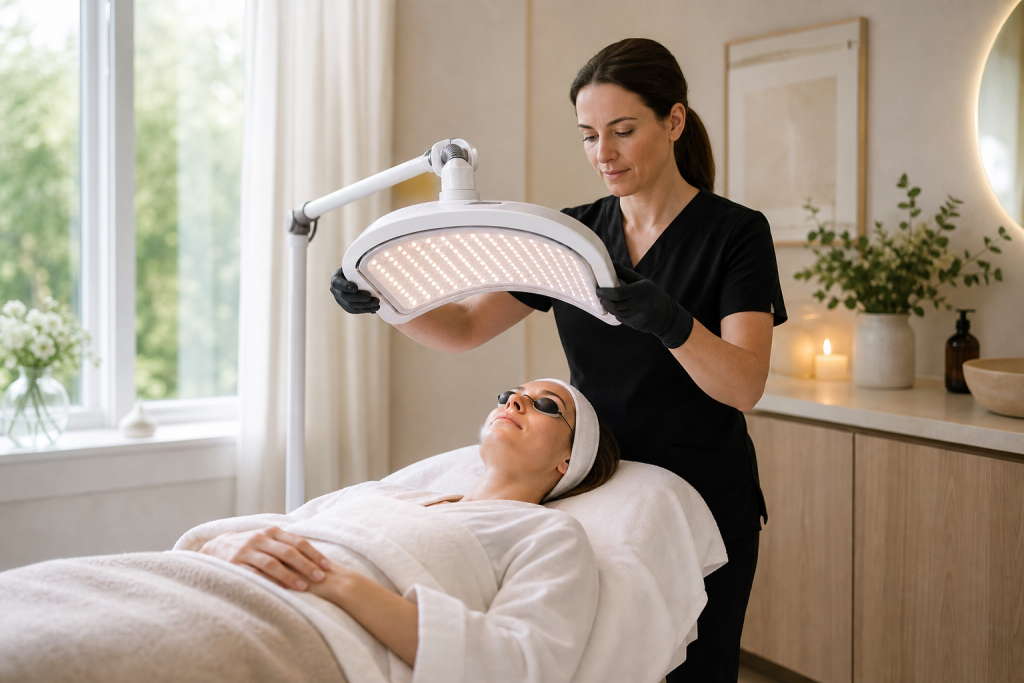
At Asal Skin Lounge in Woodland Hills, LED is offered as a professional add-on to customize results and comfort during facials. In our independent reporting and clinic practice analysis, standard professional use typically follows these steps:
- Pre-screening and consent: brief medical and topical-use history to identify photosensitizers or contraindications.
- Target selection: LED may be added to anti-aging, acne-detox, or soothing facials depending on skin needs and client goals.
- Device settings and duration: technicians use manufacturer-recommended wavelengths and session lengths; professional sessions usually last from 10 to 30 minutes depending on protocol.
- Combination with other modalities: LED is often paired with serums, facial massage, or galvanic/ high-frequency steps; it is typically used as a noninvasive adjunct rather than a stand-alone treatment.
Estimate: session timing and sequencing will vary by treatment plan and device; clients should ask for the specific protocol used during booking or consultation.
Typical immediate outcomes and client experience
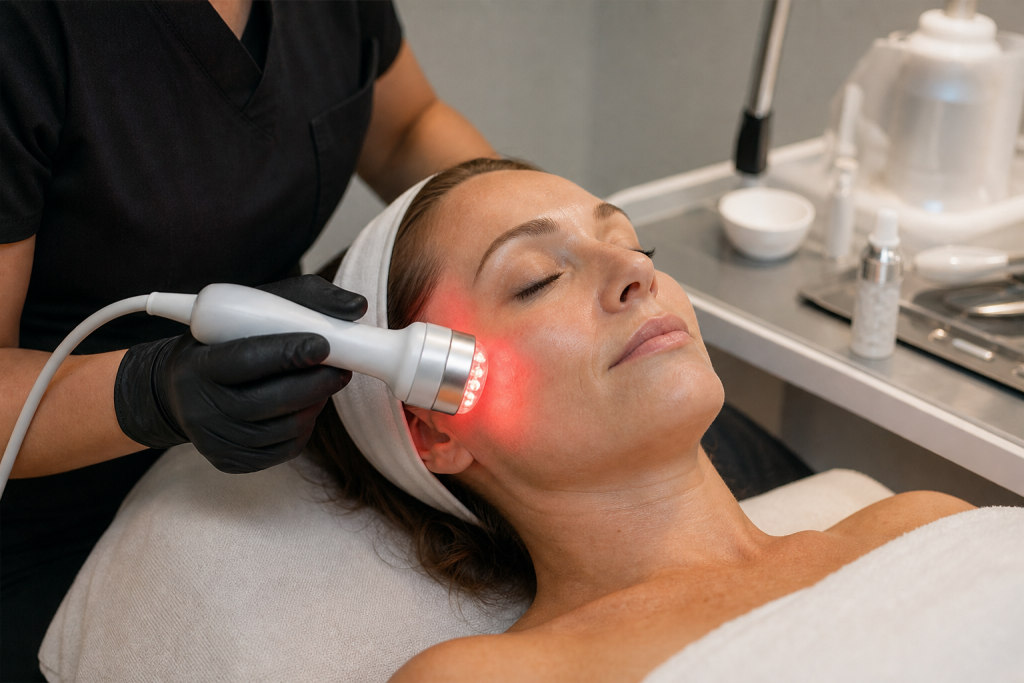
Most clients report a relaxed, warm sensation during LED. Immediate visible changes are subtle; intended short-term benefits are often comfort, temporary skin calm, and an enhanced post-facial appearance. Long-term changes depend on consistent, protocol-driven use and realistic expectations, as discussed below [1][2].
Comparing LED add-on to other common facial add-ons
| Feature | LED light therapy (add-on) | High-frequency | Galvanic deep infusion |
|---|---|---|---|
| Primary mechanism | Low-level light; cellular photoreception | Ozone generation and thermal stimulation | Electro-current to enhance serum penetration |
| Typical session length | 10–30 minutes (device-dependent) | 5–10 minutes | 5–15 minutes |
| Common indications | Soothing, photoaging adjunct, acne adjunct | Acne lesion drying, circulation boost | Hydration and active ingredient delivery |
| Reported risks | Mild transient redness; photosensitizer interactions | Mild irritation or brief tingling | Transient sensitivity if overused |
In practice, providers choose add-ons based on client goals and medical history. For example, for irritated or sensitive skin we may prefer a soothing LED protocol over stronger exfoliating modalities.
Limitations of the evidence and open questions
Confirmed fact: reviewers highlighted gaps including small trials, inconsistent dosing, and variability in outcome measures, limiting broad conclusions about comparative effectiveness and long-term safety [1][2].
Therefore, while short-term safety data in controlled settings are encouraging, more standardized long-term studies would strengthen guidance for population subgroups and specific device settings.
Cost and availability (what clients should expect)
Estimate: costs for LED add-ons vary widely by market, device type, and clinic. At luxury custom facial studios like Asal Skin Lounge in Woodland Hills, an LED add-on is typically priced as a modest upgrade to a base facial. For exact pricing and available package deals, check the Asal Skin Lounge service pages or contact the studio directly for up-to-date options.
Practical next steps for Woodland Hills clients
- Ask during booking whether the studio’s LED device model, training, and manufacturer protocols align with published safety recommendations.
- Disclose medications and recent topical procedures. If you use prescription photosensitizers or had recent chemical resurfacing, defer LED until cleared by the provider.
- Start with a single LED session as an add-on to a professional facial to assess tolerance before committing to a series.
- Track outcomes and report any unexpected sensations, prolonged redness, or changes to your provider promptly.
As of 2026-08-29, this approach reflects independent analysis of the peer-reviewed literature and FDA device summaries rather than a change in regulation or new mandate.
Summary: balancing benefits, safety, and realistic expectations
In short, LED light therapy facial add-on safety evidence suggests that professionally delivered red and near-infrared LED in controlled protocols is generally well tolerated, with mainly mild transient effects reported in clinical trials [1][2]. However, the evidence base has device and protocol variability, and FDA clearance applies to individual devices rather than to LED therapy as a single uniform category [3].
Accordingly, the safest approach is to choose a reputable provider, disclose medical history, and follow manufacturer and clinic protocols. If you live in or near Woodland Hills and are curious whether an LED add-on fits your facial plan, contact Asal Skin Lounge for a consultation.
Book with Asal Skin Lounge — Woodland Hills: For appointments or questions about LED add-ons and other facials, book online or call +1 (747) 746-3818. Our location: 19903 Ventura Blvd #3, Woodland Hills, CA 91364.
References
- Systematic and narrative reviews of LED phototherapy were used to summarize safety and trial limitations [1][2].
- FDA 510(k) clearance documentation was reviewed to explain regulatory context and device-specific clearance principles [3].
Reader FAQs
Is LED light therapy painful?
Most clients report a warm, pleasant sensation with no pain during professional LED sessions. Clinical trials generally report mild, transient sensations such as warmth or fleeting redness [1][2].
Can LED be used on acne-prone skin?
LED is commonly used as an adjunct in acne protocols and has been evaluated in trials, often with low rates of adverse events. Still, it is typically combined with other medical or topical acne treatments under provider guidance [1][2].
Do I need an eye shield during LED treatments?
Yes. Professional protocols generally include eye protection for both client and provider as a standard safety step, even when visible light wavelengths are used.
How many LED sessions do I need to see effects?
Evidence varies; some trials report changes after multiple sessions spaced over weeks. Realistically, clinicians may recommend a short series and reassessment. Discuss expectations with your provider before starting a series [1][2].

Frequently asked questions
Is LED light therapy safe for all skin tones?
Current systematic reviews show LED phototherapy was used across varied study participants and generally had a low rate of adverse events, but device parameters and protocols vary. Discuss skin-tone-specific concerns with a trained provider before treatment [1][2].
Can I combine LED with professional chemical peels or retinoid treatments?
Combining LED with active resurfacing or strong topical retinoids may increase sensitivity. Providers typically recommend screening and may postpone LED until skin has recovered or retinoid use is paused, per device guidelines and clinical judgment [1][3].
Does FDA clearance mean a device is proven effective?
FDA 510(k) clearance indicates a device is substantially equivalent to a legally marketed device for a stated indication, but it is device- and claim-specific. Clearance is not an automatic proof of effectiveness for every use or device setting; check the specific device documentation [3].
What should I ask my provider before booking an LED add-on?
Ask what device model is used, whether staff follow manufacturer protocols, how long the LED step will last, what screening they perform for photosensitizing drugs, and whether they offer a trial session or package pricing. Also disclose medications and recent procedures so the provider can advise on timing and safety [1][3].
Need practical help?
Asal Skin Lounge — Contact us to schedule service or request a quote. Service area: Woodland Hills.
Topic in context
Sources and further reading
These links were validated and checked when possible when this article was created; some publishers limit automated requests. Facts, guidance, prices, regulations, and availability can change.
- Light Emitting Diode Phototherapy for Skin Aging (review) — PubMed / Journal (2020 review) (2020-04-01)
- Light‑Emitting Diode‑Based Photodynamic Therapy for Photoaging, Scars, and Dyspigmentation: A Systematic Review — PubMed Central / Systematic review
- FDA 510(k) clearance summary for an LED facial phototherapy device (example regulatory context) — U.S. Food and Drug Administration (FDA)