
Wildfire Smoke Skin Care Woodland Hills: What to Do
wildfire smoke skin care Woodland Hills: Local guidance for wildfire smoke skin care Woodland Hills after the Nov 11, 2026 advisories. When to postpone facials…
View article sections
- 01What changed on November 11, 2026 — and why it matters
- 02Quick summary: immediate steps for wildfire smoke skin care Woodland Hills
- 03Why wildfire smoke affects skin (what the dermatology research and guidance say)
- 04Immediate at-home routine (first 72 hours while advisories are active)
- 05Which in-studio treatments to postpone — and which are generally safer
- 06Professional facials vs at-home care during smoke events
- 07Practical next steps for Woodland Hills clients (action checklist)
- 08Cost and availability considerations
- 09When to safely resume exfoliating or resurfacing treatments
- 10Frequently asked questions
- 11Final practical note and booking information for Woodland Hills clients
- 12Related guides and resources
- 13Frequently asked questions
- 14Need practical help?
- 15Topic in context
- 16Sources and further reading
wildfire smoke skin care Woodland Hills is the focus of this dated, source-based update. As a result, the article separates verified details from analysis.
What changed on November 11, 2026 — and why it matters
Confirmed fact: on November 11, 2026 the County of Los Angeles issued an extended smoke advisory after regional fires, and the South Coast Air Quality Management District extended a particle-pollution advisory due to the Alba Fire; these notices warn of elevated fine-particle (PM2.5) concentrations in the Southland air basin [1][2].
Because wildfire smoke increases airborne particles that can irritate lungs and skin, Woodland Hills clients should consider short-term changes to facial plans and daily care. This article explains what to do now, what professional treatments are safe, and how to protect the skin while the advisory is in effect.
Quick summary: immediate steps for wildfire smoke skin care Woodland Hills
- Stay informed: the advisories were issued on November 11, 2026; monitor local updates from LA County and South Coast AQMD [1][2].
- Stay mostly indoors and limit outdoor exertion while particle pollution is elevated; consider N95 or better masks for necessary outdoor trips per public-health guidance [2][3].
- Avoid aggressive professional and at-home resurfacing until air quality improves (chemical peels, microneedling, lasers, and microdermabrasion are higher risk).
- Opt for gentle hydrating facials, barrier-repair treatments, and calming modalities if you visit a studio; ask the esthetician to delay extractions or exfoliation when skin is inflamed or sensitive.
Confirmed facts and official notices (short)
Official announcement: the County of Los Angeles published an extended smoke advisory on November 11, 2026; South Coast AQMD published a particle-pollution advisory tied to the Alba Fire the same day [1][2].
Independent public-health guidance: federal and state agencies advise limiting outdoor exposure and using appropriate masks during elevated particulate events; they also publish cleanup and hygiene guidance after wildfire smoke and ash exposure [3].
Why wildfire smoke affects skin (what the dermatology research and guidance say)
Independent reporting and dermatology literature show that smoke exposes skin to airborne particulate matter and volatile organic compounds that increase oxidative stress and irritation, worsen redness, and can aggravate acne or eczema-prone skin [4].
Analysis: particles sit on the skin surface and can compromise the skin barrier, so cleansing and barrier repair are practical priorities while advisories are active. However, aggressive resurfacing may worsen inflammation if the barrier is already stressed [4].
Immediate at-home routine (first 72 hours while advisories are active)
When the air is smoky, focus on calming and protecting the skin. The following at-home sequence is analysis-based, general educational information—not medical advice.
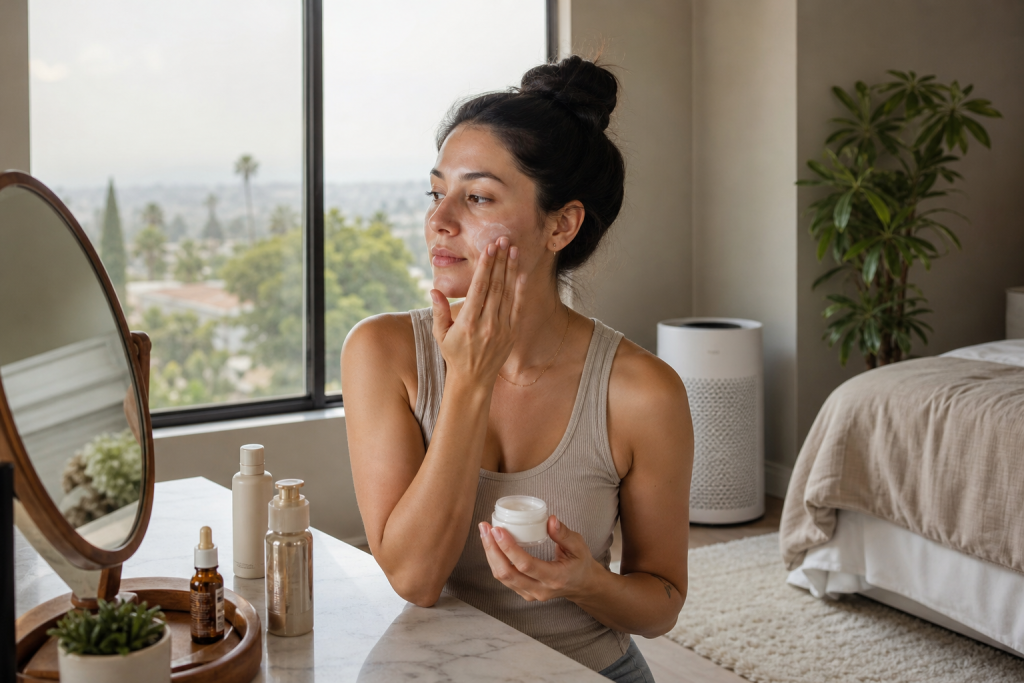
- Rinse or cleanse gently twice daily. Use a mild, fragrance-free cleanser to remove soot, vehicle exhaust, and particles without stripping natural oils.
- Pat dry and apply a lightweight barrier moisturizer with ceramides or fatty acids within one minute of cleansing.
- Use an antioxidant serum (vitamin C or niacinamide) in the morning to help neutralize oxidative stress if your skin tolerates it.
- Avoid physical scrubs, at-home acids, or aggressive exfoliants until air quality returns to safe levels and your skin feels calm.
- Indoors, run a HEPA air purifier and keep windows closed to reduce indoor particle load; follow local guidance for ventilation if smoke levels decline [1][2][3].
Products to prioritize (general categories)
- Gentle cream or gel cleansers labeled for sensitive skin.
- Moisturizers with ceramides, hyaluronic acid, or petrolatum for barrier support.
- Antioxidant serums used cautiously and only if skin is not reactive.
- Physical sun protection outdoors if you must go out; but during heavy smoke, focus on masks and staying indoors per AQMD/CDC recommendations [2][3].
Which in-studio treatments to postpone — and which are generally safer
Asal Skin Lounge analysis for Woodland Hills clients: postpone resurfacing and barrier-disrupting treatments when smoke advisories are active. These include:
- Chemical peels (medium or deep) — postpone until skin has recovered and air quality improves.
- Microneedling and ablative lasers — postpone due to infection and inflammation risk in compromised skin.
- Microdermabrasion and aggressive manual exfoliation — suggest postponement if skin appears red or irritated.
Safer professional options to consider instead (depending on individual skin and with esthetician assessment):
- Hydrating and barrier-repair facials that focus on gentle cleansing, hydration, and calming masks.
- Lymphatic facial massage to reduce puffiness and promote circulation without abrasion.
- Non-invasive LED light therapy for calming inflammation, used as an adjunct to a gentle facial.
- High-frequency treatments for acne-prone skin only if the skin is not inflamed; consult your esthetician first.
Table: common facial services and whether to proceed during smoke advisories
| Service | Short-term recommendation | Why |
|---|---|---|
| Hydrating/Barrier Repair Facial | Can proceed with caution | Supports barrier recovery and removes surface particles without harsh exfoliation. |
| Extraction-focused Deep Clean | Proceed only if not inflamed; consider gentler approach | Extractions can introduce irritation; esthetician should assess skin condition first. |
| Chemical Peel / Microneedling / Laser | Postpone until air quality improves and skin recovers | Risk of prolonged inflammation, infection, and poor healing when barrier is compromised. |
| LED Light Therapy | Generally safe as an add-on | Non-abrasive, may help calm inflammation when used appropriately. |
| Microdermabrasion | Postpone | Abrasive exfoliation is likely to increase irritation during smoke exposure. |
Professional facials vs at-home care during smoke events
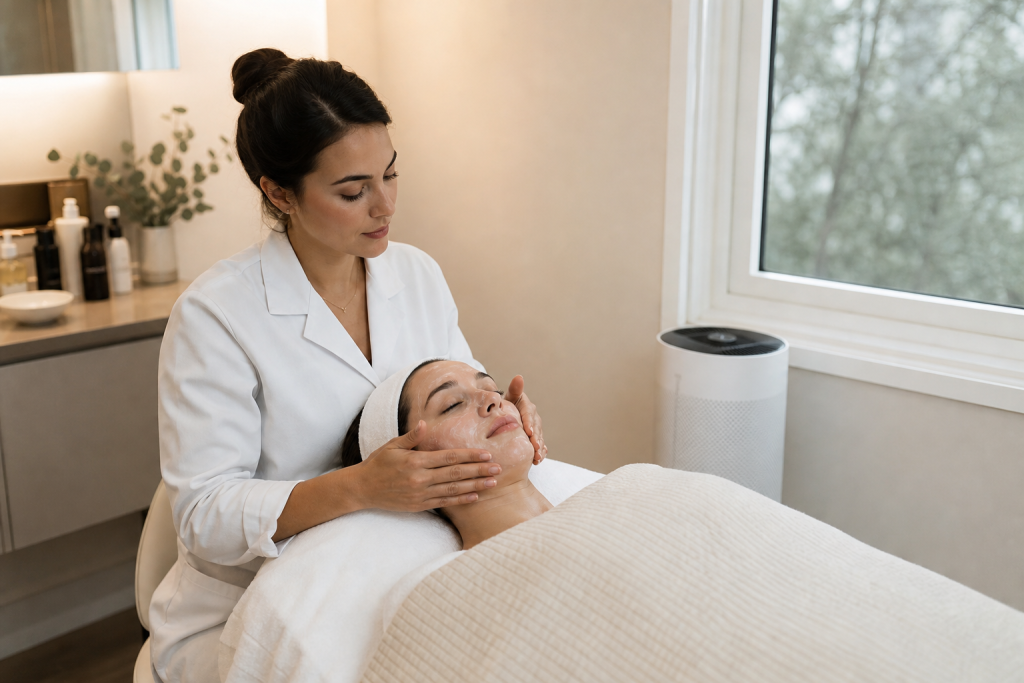
Professional facials offer esthetician assessment, controlled barrier repair protocols, and in-clinic hygiene measures. During smoke advisories, that supervision helps tailor treatments to skin reactivity.
At-home care is essential between visits: consistent cleansing, barrier moisturization, and limiting irritants. For many clients, a short-term combination works best: defer aggressive in-studio procedures but book a gentle, hydrating appointment when you need professional-level barrier repair. This approach balances safety with visible skin comfort.
Practical next steps for Woodland Hills clients (action checklist)
- Check current air-quality notices. Confirm that the Nov 11, 2026 advisories remain in effect or have been updated; follow LA County and South Coast AQMD for changes [1][2].
- If you have a pending appointment for resurfacing, contact Asal Skin Lounge to discuss rescheduling or swapping to a gentle hydrating facial.
- Book a short consultation or hydrating facial if your skin feels tight, itchy, or congested; avoid treatments that remove the surface protective layer until advised otherwise.
- If you must go outside, use an N95-style respirator for particle protection and reduce exertion outdoors [3].
Cost and availability considerations
Estimate: many studios, including Asal Skin Lounge, may have flexible rescheduling policies during regional advisories. Treatment availability may shift as more clients reschedule. Contact the studio for current booking options and any deposit or cancellation policy updates.
Analysis: switching to a shorter hydrating appointment or adding LED therapy can be a lower-cost alternative to postponing entirely while still offering professional care.
When to safely resume exfoliating or resurfacing treatments
Estimate and practical rule: wait until air quality is back to normal and your skin shows no signs of active irritation for at least 7–14 days. Ask your esthetician for an in-person assessment before scheduling medium or deep procedures. Official air-quality status can change; always verify after advisories lift [1][2].
Official and authoritative sources cited
Official announcements: County of Los Angeles extended smoke advisory (Nov 11, 2026) and South Coast AQMD particle-pollution advisory due to the Alba Fire (Nov 11, 2026) [1][2].
Independent guidance on wildfire safety and post-fire cleanup is available from the CDC; dermatology context on smoke and skin comes from the American Academy of Dermatology (AAD) [3][4].
Frequently asked questions
Q: Should I wear sunscreen during a smoke advisory?
A: Yes. Sunscreen remains important if you go outdoors because UV exposure continues; however, public-health guidance emphasizes minimizing outdoor time and wearing particle-protective masks when air quality is poor [2][3].
Q: Is it safe to get extractions or a deep-clean facial while smoke is in the air?
A: It depends on your skin’s current condition. If your skin shows redness, irritation, or sensitivity, postpone extractions. If your esthetician deems skin calm, a gentle extraction session with strict hygiene may be possible, but avoid forceful or aggressive work during advisories.
Q: How soon after smoke clears can I have a chemical peel or laser?
A: Wait until air quality returns to normal and your skin has fully settled—usually at least 7–14 days. Schedule a consultation so an esthetician can confirm your skin’s readiness.
Q: Can I use retinoids or acids at home during smoke events?
A: If your skin is already reactive, pause retinoids and strong acids until the skin calms. If your skin tolerates them and is not inflamed, discuss continued use with your esthetician to avoid over-irritation.
Q: Are air purifiers helpful indoors?
A: Yes. A HEPA-rated air purifier reduces indoor particulate concentrations and helps limit the amount of smoke particles that settle on skin and surfaces, supporting a cleaner environment while the advisory is active [3].
Final practical note and booking information for Woodland Hills clients
Confirmed fact: the air-quality advisories were issued on November 11, 2026 and may be extended or lifted based on evolving fire and weather conditions; check LA County and South Coast AQMD for updates [1][2].
Asal Skin Lounge in Woodland Hills recommends conservative, barrier-supportive care during elevated smoke conditions and prefers to reschedule high-risk procedures until the air clears. If you need professional help for irritated or congested skin, book a gentle hydrating facial, LED therapy, or a short consult so we can recommend a safe plan tailored to your skin.
Book online or call +1 (747) 746-3818 to discuss appointments, rescheduling, or immediate hydrating options. We are located at 19903 Ventura Blvd #3, Woodland Hills, CA 91364.


Frequently asked questions
Should I delay my scheduled chemical peel because of wildfire smoke?
Yes—postpone medium and deep chemical peels while particle-pollution advisories are active and until your skin has settled. Smoke exposure can increase inflammation and the risk of complications. Contact Asal Skin Lounge to reschedule or convert the appointment to a calming, hydrating facial.
What immediate at-home steps protect skin during smoke advisories?
Gently cleanse twice daily, apply a ceramide-rich moisturizer to support the skin barrier, use antioxidants if tolerated, avoid scrubs and acids, run a HEPA air purifier indoors, and limit outdoor time. These are general educational recommendations—not personalized medical advice.
Are LED facials safe during smoky conditions?
Generally, yes. LED light therapy is non-abrasive and can be used as an adjunct to calming facials, but an esthetician should assess your skin first to confirm it isn’t actively irritated.
How long after the smoke clears should I wait before getting resurfacing treatments?
A practical guideline is to wait until air quality returns to normal and your skin shows no active irritation for at least 7–14 days. Schedule a consult so an esthetician can evaluate readiness for resurfacing.
Need practical help?
Asal Skin Lounge — Contact us to schedule service or request a quote. Service area: Woodland Hills.
Topic in context
Sources and further reading
These links were validated and checked when possible when this article was created; some publishers limit automated requests. Facts, guidance, prices, regulations, and availability can change.
- Extended Smoke Advisory – COUNTY OF LOS ANGELES — County of Los Angeles (2026-11-11) — primary source
- South Coast AQMD extends particle pollution advisory due to the Alba Fire — November 11, 2026 (press release/PDF) — South Coast Air Quality Management District (2026-11-11) — primary source
- Safety Guidelines: After a Wildfire — Centers for Disease Control and Prevention (CDC) (2026-09-01)
- How climate change and wildfire smoke can impact the skin — American Academy of Dermatology (AAD) (2023-05-03)