
PFAS in cosmetics what to know – Woodland Hills guide
PFAS in cosmetics what to know: PFAS in cosmetics what to know for Woodland Hills clients: recent regulator moves, safety gaps, product choices at facials, and…
View article sections
- 01Table of contents
- 02What changed, exactly — and why it matters to Woodland Hills clients (October 2026)
- 03Quick opening summary for appointment planning
- 04Why the FDA couldn’t make a final safety determination
- 05PFAS in cosmetics what to know: common product categories and exposure considerations
- 06How facials, makeup services, and add-ons affect exposure
- 07Practical steps to reduce potential PFAS exposure at the salon
- 08What to expect from regulations, availability, and cost
- 09Comparing professional facials, at-home care, and PFAS risk
- 10How Asal Skin Lounge supports informed choices (Woodland Hills)
- 11Limitations, uncertainties, and what is under review
- 12Practical checklist before your next appointment
- 13Frequently asked questions
- 14Related guides and resources
- 15Frequently asked questions
- 16Need practical help?
- 17Topic in context
- 18Sources and further reading
Quick summary: Regulators have highlighted data gaps on PFAS in cosmetics and begun taking regional action, while manufacturers are starting to reformulate. Salon clients can reduce potential exposure by asking about brands, requesting PFAS-free or rinse-off alternatives, or bringing trusted products to appointments.
Estimated reading time: 10 minute read
Table of contents
- What changed, exactly — and why it matters to Woodland Hills clients (October 2026)
- Quick opening summary for appointment planning
- What are PFAS and why are they used in cosmetics?
- Confirmed facts and official findings (as of October 14, 2026)
- Why the FDA couldn’t make a final safety determination
- PFAS in cosmetics what to know: common product categories and exposure considerations
- How facials, makeup services, and add-ons affect exposure
- Practical steps to reduce potential PFAS exposure at the salon
- What to expect from regulations, availability, and cost
- Comparing professional facials, at-home care, and PFAS risk
- How Asal Skin Lounge supports informed choices (Woodland Hills)
- Limitations, uncertainties, and what is under review
- Practical checklist before your next appointment
- Frequently asked questions
- Q: Are salons legally required to label PFAS in products?
- Q: Can I test products for PFAS at home?
- Q: Should I cancel my facial if I’m concerned about PFAS?
- Q: Will the EU’s PFHxA limit affect product availability in the U.S.?
- Q: How can I verify a product is PFAS-free?
- Related guides and resources
- Frequently asked questions
- Are salons required to disclose PFAS in the products they use?
- How can I reduce PFAS exposure during a facial or makeup service?
- Will new rules make all cosmetics PFAS-free?
- Can I test a product for PFAS myself?
- Need practical help?
- Topic in context
- Sources and further reading
PFAS in cosmetics what to know is the focus of this dated, source-based update. As a result, the article separates verified details from analysis.
What changed, exactly — and why it matters to Woodland Hills clients (October 2026)
On October 12, 2026, trade reporting highlighted renewed attention to PFAS in cosmetics after the U.S. Food and Drug Administration (FDA) said it could not yet conclude whether PFAS in cosmetics are safe because of data gaps; that reporting followed an FDA assessment released December 29, 2025. This matters if you get facials, makeup services, or buy skincare products in Woodland Hills, because the question affects product transparency and the range of PFAS-free alternatives available locally [1][2]. Additionally, the European Union announced a new limit on one PFAS compound (PFHxA) for cosmetics on October 10, 2026, which is likely to influence product formulations and availability worldwide [3].
Quick opening summary for appointment planning
PFAS in cosmetics what to know: regulators have identified data gaps but also started to act, manufacturers are beginning to reformulate in response, and salon clients can reduce risk by asking about ingredients, choosing PFAS-free brands, and requesting alternative products during facials and makeup services.
What are PFAS and why are they used in cosmetics?
Per- and polyfluoroalkyl substances (PFAS) are a broad family of synthetic chemicals prized for water-, oil-, and stain-resistance. In cosmetics, they appear in formulas that promise long wear, smoother feel, water resistance, or a silky finish. Because PFAS include thousands of related chemicals, they may show up under different ingredient names or as impurities in raw materials.
Confirmed facts and official findings (as of October 14, 2026)
- Official: The FDA published an assessment on PFAS in cosmetic products and associated risks on December 29, 2025; the report noted evidence gaps that prevent a definitive safety conclusion [1].
- Independent reporting: Trade press and industry analysis on October 12, 2026 emphasized the FDA’s inability to rule out safety concerns and called attention to the need for better data and testing [2].
- Regulatory action: The EU finalized a limit on PFHxA in cosmetics on October 10, 2026; that regulatory move is likely to affect global supply chains and reformulation efforts [3].
Why the FDA couldn’t make a final safety determination
The FDA’s assessment identified gaps in exposure data, analytical methods, and ingredient transparency that make it hard to estimate consumer exposure across all product types and to link exposure to health outcomes reliably. In short, regulators do not yet have complete, consistent measurements of PFAS levels in the full range of cosmetics, which complicates risk assessments and safety conclusions [1]. Independent coverage noted these same gaps and urged more testing and supply-chain transparency [2].
PFAS in cosmetics what to know: common product categories and exposure considerations
If you’re deciding which products to let a technician use during a facial or to buy in-studio, it helps to know where PFAS show up most often. Below is a practical comparison.
| Product type | Why PFAS may be used | Relative likelihood of presence | Practical salon note |
|---|---|---|---|
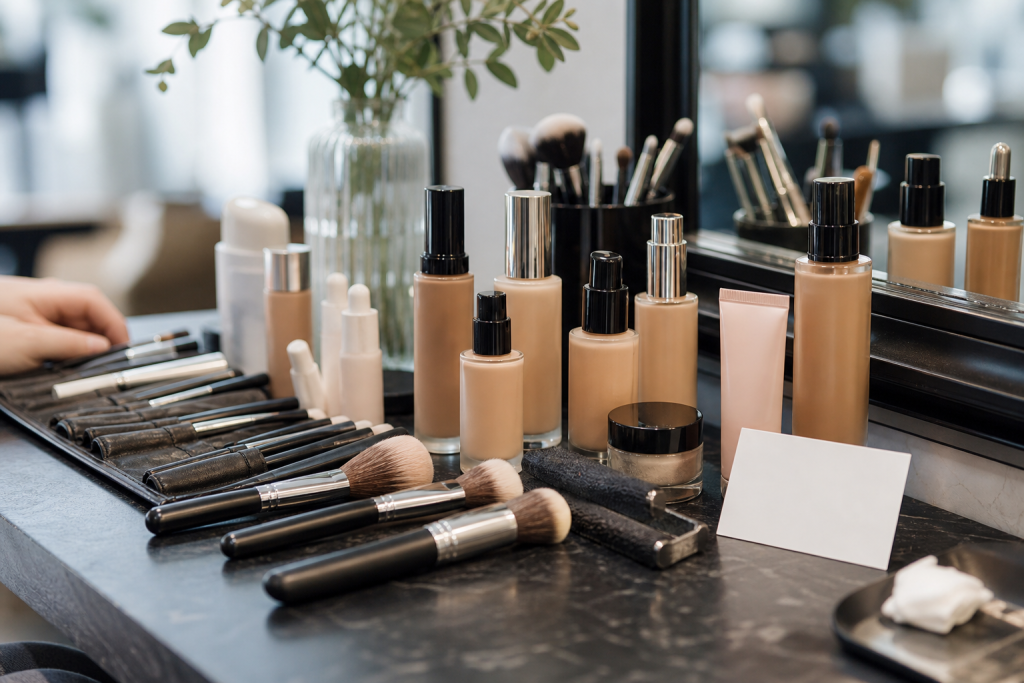
| Long-wear foundations, primers, concealers | Improves spread, transfer resistance, durability | Higher | Ask about PFAS-free long-wear options for makeup services |
| Waterproof mascaras, eyeliners, brow products | Provides water- and smudge-resistance | Moderate to higher | Technicians can use non-PFAS waterproof alternatives on request |
| Primer and blurring skin finishes | Creates silky, pore-blurring textures | Moderate | Opt for silicone- or polymer-based blurring agents without fluorination |
| Sunscreen lotions and creams | Can appear as processing aids or formulation stabilizers | Variable | Check with brand or labelling; choose mineral sunscreens to reduce some formulation risks |
| Skincare serums, oils, moisturizers | Less common but possible as impurities | Lower to moderate | Look for brands that publish full ingredient sourcing or PFAS testing |
These relative likelihoods are general guidance rather than definitive statements — because testing and disclosure remain incomplete, there’s uncertainty about presence and concentrations in many products [1][2].
How facials, makeup services, and add-ons affect exposure
PFAS in cosmetics what to know for salon clients: exposure depends on product type, application frequency, and whether products are left on the skin or wiped off. For example, a long-wear foundation used daily may create more opportunity for exposure than a one-time wash-off mask. Furthermore, leave-on makeup or products applied near the eyes or mouth may increase routes of transfer.
That said, facials usually use professional-grade products in controlled amounts, and many technicians rinse or remove products during treatment. Nevertheless, clients who prefer to minimize potential PFAS contact can ask their esthetician to use PFAS-free—or explicitly labeled—alternatives for both treatments and makeup services.
Practical steps to reduce potential PFAS exposure at the salon
- Ask the salon which specific brands and product lines will be used during your appointment. Then check brand ingredient statements or contact the brand directly if you’re concerned.
- Request PFAS-free alternatives during booking or on arrival. Many professional product lines offer long-wear or waterproof performance without fluorinated chemistries.
- Prefer rinse-off options where appropriate (for example, masks and cleansers) rather than leave-on treatments when you want to err on the side of caution.
- Bring your own trusted, PFAS-free foundation or primer for makeup services. If you plan to purchase products in-studio, ask for full ingredient lists before buying.
- Ask the technician to document which products were used, so you can review ingredient lists later if needed.
What to expect from regulations, availability, and cost
As of October 14, 2026, regulators are actively examining PFAS in cosmetics but have not issued a U.S.-wide ban or specific limits; the FDA report highlighted the need for more data rather than announcing regulatory limits [1]. Industry coverage on October 12, 2026 emphasized those same data gaps and reported that the FDA cannot yet conclude safety for all PFAS uses in cosmetics [2]. Meanwhile, the EU’s October 10, 2026 limit on PFHxA is an example of regional regulatory pressure that may accelerate reformulations and increase PFAS-free product availability globally [3].
Practically, PFAS-free professional products are increasingly available, but price and selection vary by brand and performance. Some PFAS-free long-wear or waterproof formulations may cost more because manufacturers invest in alternative chemistries and testing; however, as reformulation expands, competitive pricing is likely to improve.
Comparing professional facials, at-home care, and PFAS risk
| Dimension | Professional facial | At-home care |
|---|---|---|
| Product control | Higher — technician can select PFAS-free professional lines on request | Depends on consumer choice; ingredient reading required |
| Exposure frequency | Lower for occasional visits; higher if frequent and using leave-on products | Potentially higher if daily use of questionable products |
| Transparency | Good when salon shares brand lists; limited if brands don’t disclose fully | Varies; product labels can omit processing aids or trace impurities |
| Ability to customize | High — technicians can substitute alternatives and tailor treatment | High if you buy intentionally PFAS-free products |
How Asal Skin Lounge supports informed choices (Woodland Hills)
As a luxury custom facial studio in Woodland Hills, our approach is to prioritize ingredient transparency and client preferences. If you prefer PFAS-free products for a hydrating facial, anti-aging treatment, or makeup application, let us know when you book so we can plan appropriate product choices and add-ons such as LED light therapy, high frequency, or galvanic deep infusion without introducing unwanted chemistries. We can also recommend PFAS-free retail options and note which brands and lines we use during your service.
Limitations, uncertainties, and what is under review
Analysis: The main limitations are incomplete market-wide testing, inconsistent labeling, and the sheer number of PFAS-related chemicals. Although regulators and industry are responding, it will take time for data-driven limits or broad reformulation to be adopted globally. For that reason, both the FDA’s December 2025 report and subsequent trade coverage stressed that uncertainty remains and more testing is needed [1][2].
Practical checklist before your next appointment
- During booking, state that you prefer PFAS-free products if that’s important to you.
- Ask which product lines will be used and request ingredient lists when possible.
- Bring your own makeup or skincare for use during appointment if it helps you feel safer.
- Choose rinse-off treatments after trying a new product, then purchase only if comfortable.
Frequently asked questions
Q: Are salons legally required to label PFAS in products?
A: No. Confirmed: In the U.S., ingredient labeling requirements do not yet require manufacturers to disclose every PFAS-related impurity or processing aid; this limited disclosure was one reason the FDA said more data are needed to assess risk [1].
Q: Can I test products for PFAS at home?
A: No simple at-home test provides reliable PFAS profiling. Analysis requires specialized laboratory methods. If you need confirmation for a particular product, third-party lab testing is the rigorous option, although it can be costly and slow.
Q: Should I cancel my facial if I’m concerned about PFAS?
A: Not necessarily. Instead, communicate your preferences when booking. Request PFAS-free or rinse-off alternatives, bring your own products, or ask the technician to avoid long-wear or waterproof makeup for the appointment.
Q: Will the EU’s PFHxA limit affect product availability in the U.S.?
A: Estimate: Regional rules often influence global formulations because manufacturers sell to multiple markets. The EU limit on PFHxA announced October 10, 2026 may accelerate reformulation and increase PFAS-free product options in the U.S. over time [3].
Q: How can I verify a product is PFAS-free?
A: Look for brands that state they test for PFAS and publish results, review independent third-party testing when available, or choose products labeled explicitly as PFAS-free along with full ingredient disclosure. Keep in mind that label claims are useful but not infallible given supply-chain complexity.
PFAS in cosmetics what to know: regulators have begun to act, data gaps remain, and consumers can reduce potential exposure through informed choices and clear communication with their salon. Asal Skin Lounge supports clients who prefer PFAS-free products — please tell us your preference when you book so we can prepare the right products and experience for you.
Book online or call +1 (747) 746-3818 to schedule a custom facial or makeup service in Woodland Hills.


Frequently asked questions
Are salons required to disclose PFAS in the products they use?
No. In the U.S., manufacturers are not currently required to disclose every PFAS-related impurity or processing aid on cosmetic ingredient lists. The FDA’s 2025 assessment highlighted these disclosure and data gaps and called for more testing and transparency [1].
How can I reduce PFAS exposure during a facial or makeup service?
Request PFAS-free or rinse-off alternatives when you book, bring your own trusted products, ask the salon for brand and ingredient lists, and choose non-fluorinated long-wear alternatives for makeup. Clear communication before the appointment helps the technician plan substitutions.
Will new rules make all cosmetics PFAS-free?
Not immediately. As of October 14, 2026, regulators are investigating and some regions like the EU have adopted limits for specific compounds, such as PFHxA. Over time these actions may prompt wider reformulation, but market change will be gradual [1][3].
Can I test a product for PFAS myself?
No reliable at-home PFAS tests exist. Accurate measurement requires specialized laboratory analysis. If you want definitive results, third-party lab testing is the rigorous approach, but it can be expensive.
Need practical help?
Asal Skin Lounge — Contact us to schedule service or request a quote. Service area: Woodland Hills.
Topic in context
Sources and further reading
These links were validated and checked when possible when this article was created; some publishers limit automated requests. Facts, guidance, prices, regulations, and availability can change.
- Report on the Use of PFAS in Cosmetic Products and Associated Risks (FDA) — U.S. Food & Drug Administration (2025-12-29) — primary source
- FDA Cannot Rule on PFAS Safety in Cosmetics: Data Gaps Explained — INCI File (2026-10-12)
- EU cosmetics face PFHxA limits as REACH transition ends — Personal Care Insights (2026-10-10)