
MoCRA cosmetics update 2026 Woodland Hills — Current Guide
MoCRA cosmetics update 2026 Woodland Hills: MoCRA cosmetics update 2026 Woodland Hills explains the FDA’s Oct 2026 labeling, reporting, and registration change…
View article sections
- 01MoCRA cosmetics update 2026 Woodland Hills: quick summary for spa clients
- 02What MoCRA requires (confirmed by the FDA)
- 03How MoCRA affects the products you see at Asal Skin Lounge (practical impact)
- 04Comparison: professional in-spa products vs. over-the-counter cosmetics
- 05Practical next steps for Woodland Hills clients
- 06Costs, availability, and likely issues (estimates and analysis)
- 07What Asal Skin Lounge is doing (local practice and client reassurance)
- 08Sources and further reading
- 09Frequently asked questions
- 10Related guides and resources
- 11Frequently asked questions
- 12Need practical help?
- 13Topic in context
- 14Sources and further reading
MoCRA cosmetics update 2026 Woodland Hills is the focus of this dated, source-based update. As a result, the article separates verified details from analysis.
What changed, when, and why it matters: On October 22, 2026 the U.S. Food and Drug Administration (FDA) published new guidance and dashboard updates implementing provisions of the Modernization of Cosmetics Regulation Act (MoCRA), and related materials continued to appear through October 24, 2026. These materials clarify how cosmetics companies must register facilities, list products, keep records, and report serious adverse events to the FDA — changes that affect the professional products spas use and the labels you see in Woodland Hills treatment rooms [1][2].
This article summarizes confirmed FDA requirements, independent reporting about what the law means for manufacturers, and practical, local guidance for Asal Skin Lounge clients in Woodland Hills, Tarzana, Encino, and nearby neighborhoods. It also explains realistic limitations and the sensible next steps you can take when booking facials or buying cosmetics.
MoCRA cosmetics update 2026 Woodland Hills: quick summary for spa clients
Confirmed facts (official): MoCRA requires certain cosmetics firms to register facilities, submit product listings, maintain records and samples, and report serious adverse events to the FDA; the agency published implementing guidance and a public dashboard in October 2026 to help firms comply [1][2].
Independent reporting and analysis: Observers described these changes as giving the FDA new, more active tools for oversight — a shift from the previous regulatory baseline — and said manufacturers now face clearer deadlines and new reporting obligations [3].
Why this matters to Woodland Hills spa clients: the products your esthetician uses and sells in-clinic are increasingly traceable to manufacturers and reporting systems. That can improve transparency when issues arise, but it does not change the clinical nature of a facial appointment or guarantee outcomes.
Top takeaways for clients
- Manufacturers and some distributors must register and list products with the FDA; as a result, professional products used at spas are more likely to be documented in federal records [1].
- Serious adverse events associated with a cosmetic now must be reported to the FDA, which helps the agency spot safety signals faster [1].
- FDA guidance published in October 2026 clarifies definitions and timelines; however, implementation continues and details will evolve, so expect progressive rollout of enforcement and guidance documents (as of Oct 24, 2026) [1][2].
- For clients, the practical benefits are clearer product sourcing and the ability to ask spas about product listings and incident reporting practices; but MoCRA doesn’t replace patch testing or professional judgment at the point of care.
What MoCRA requires (confirmed by the FDA)
Per the FDA’s public materials, MoCRA established a set of requirements for cosmetics businesses. Key confirmed duties include:
- Facility registration and product listing submissions to the FDA for eligible firms [1].
- Submission of reports for serious adverse events that may be associated with cosmetic use [1].
- Preservation of product records and—when required—retention samples for inspection or review [1].
- New FDA guidance and resources to help stakeholders understand how to comply, published in October 2026 [2].
These requirements are confirmed in the FDA’s MoCRA materials and the agency’s Cosmetics News & Events updates [1][2].
What MoCRA does not do (confirmed and important limitations)
- MoCRA is not a clinical practice rule for estheticians; it governs manufacturers, packers, and distributors. Client care standards remain set by state cosmetology and local licensing bodies.
- The law increases regulatory transparency, but it does not guarantee that every product is free of risk for every person. Patch testing and professional assessment remain essential before treatments that use active ingredients.
- Guidance and enforcement timelines continue to roll out, so obligations and FDA tools are still being implemented as of Oct 24, 2026 [1][2].
How MoCRA affects the products you see at Asal Skin Lounge (practical impact)
For clients of a Woodland Hills spa, the most immediate changes are about traceability and communication, not treatment technique. Expect the following practical effects:
- Greater traceability: manufacturers supplying professional serums, peels, and oils should appear in FDA product listings if they meet the filing criteria, which makes it easier for spas to verify ingredient declarations and supplier status [1].
- Faster detection of safety signals: when a product is linked to a serious adverse event, FDA reports should surface information more quickly, helping spas and clients make informed choices [1].
- Stronger supply documentation: spas will likely request Certificates of Analysis, batch numbers, and product lot records from suppliers to meet their own recordkeeping and to respond to client questions faster.
Service-level changes you may notice
- Estheticians may ask additional questions about client medical history and prior reactions and may emphasize patch testing before aggressive peels or resurfacing add-ons.
- Spas may keep more robust logs of which lot numbers were used for specific clients and how products were stored.
- When a client reports an unexpected, serious reaction, spas will have clearer pathways to report and to assist the client in submitting an FDA report if needed.
Comparison: professional in-spa products vs. over-the-counter cosmetics
Below is an accessible, confirmed comparison of regulatory considerations that matter to clients in Woodland Hills:
| Dimension | Professional in-spa products | Over-the-counter (retail) cosmetics |
|---|---|---|
| FDA product listing | Likely listed if manufacturer/distributor is covered by MoCRA requirements [1] | Often listed; depends on manufacturer compliance [1] |
| Adverse event reporting | Serious events must be reported to FDA if associated with a product under MoCRA rules [1] | Same reporting requirement for serious events; retail products are included under MoCRA reporting duties [1] |
| Recordkeeping and sample retention | Manufacturers must keep records; spas often keep batch/lot logs for client safety | Manufacturers must keep records; consumers rely on labeling and retailer return policies |
| Labeling and ingredient transparency | Professional labels may be less consumer-focused but must meet ingredient and identification requirements | Retail labels are consumer-facing and generally provide ingredient lists and directions |
Practical next steps for Woodland Hills clients
As a local client, you can take simple steps to benefit from the MoCRA changes without waiting for additional federal actions:
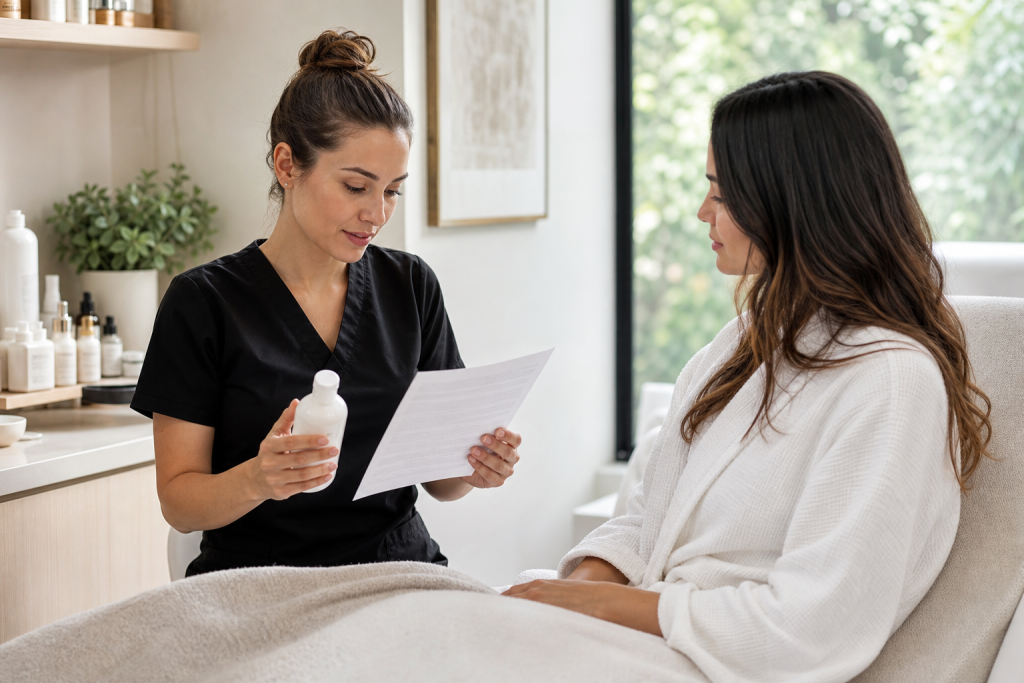
- Ask your esthetician which products will be used and request the product name, lot number, and manufacturer when you want it. Spas that follow MoCRA-aware practices should be able to provide this information quickly.
- Request a patch test before peels, concentrates, or new clinical-strength actives, and follow post-treatment care instructions to reduce irritation risk.
- If you experience an unexpected, serious reaction after a cosmetic service or product, inform the spa immediately and ask about reporting to the FDA; serious adverse events associated with cosmetics are reportable under MoCRA [1].
- Prefer suppliers and brands that provide Certificates of Analysis and transparent ingredient details; this helps salons comply with recordkeeping and gives you more confidence in product provenance.
Costs, availability, and likely issues (estimates and analysis)
Estimate: Compliance costs fall mainly on manufacturers and distributors (registration, submissions, record systems). Spas may incur modest administrative costs to track batch numbers, collect COAs, and maintain logs. These burdens may be passed through in marginal price changes for professional-grade products and services.
Likely issues during rollout: expect phased implementation and some confusion as smaller suppliers update their systems. The FDA’s October 2026 guidance attempts to clarify obligations, but ongoing updates are likely as the agency receives industry questions and refines its dashboard and instructions [2].
What Asal Skin Lounge is doing (local practice and client reassurance)
Analysis & local practice: At Asal Skin Lounge in Woodland Hills we track product lot numbers used during appointments, maintain supplier documentation, recommend patch tests for new actives, and prioritize transparent communication about ingredients and aftercare. You may be asked to sign treatment consent forms that include noted product lots and application details.
These steps are consistent with the spirit of MoCRA’s transparency and reporting goals, and they help us serve clients safely while federal guidance continues to evolve.
Sources and further reading
Confirmed official sources: FDA MoCRA overview and related guidance, including the Cosmetics News & Events updates published in October 2026 [1][2]. Independent reporting: Axios summarized earlier developments and the regulatory shift in 2024 [3].
How to stay updated
Because MoCRA implementation is ongoing, check the FDA cosmetics pages and the agency’s news updates for new guidance after Oct 24, 2026. You can also ask your spa or product supplier for the latest compliance and safety documents.
Frequently asked questions
1. Will MoCRA make my facial safer?
Short answer: MoCRA improves product traceability and federal oversight, which helps identify safety issues faster, but it does not replace clinical precautions like patch testing or professional assessment. Always discuss sensitivities and medical history with your esthetician.
2. If I have a bad reaction, can I report it to the FDA?
Yes. MoCRA requires serious adverse events linked to cosmetics to be reported to the FDA. Spas can assist clients in submitting reports, and the FDA’s website describes reporting procedures and definitions [1].
3. Will spas in Woodland Hills stop using certain products because of MoCRA?
Not automatically. Some small or foreign suppliers may need time to comply. Spas may transition to suppliers that meet registration and listing expectations or that provide clear batch records and COAs to meet evolving best practices.
4. How can I verify a product my esthetician plans to use?
Ask for the full product name, manufacturer, batch/lot number, and any Certificates of Analysis. If the product is listed with the FDA under MoCRA, that listing can provide additional confirmation; otherwise, supplier documentation is useful.
5. When will these rules be fully enforced?
Enforcement and guidance have been rolling out through 2026. The FDA published guidance and dashboard updates in October 2026, but implementation details may continue to evolve. Check the FDA’s MoCRA page and cosmetics news for updates [1][2].
Sources: FDA Modernization of Cosmetics Regulation Act overview and October 2026 cosmetics news releases (official) [1][2]; independent reporting and analysis on the regulatory shift (Axios) [3].
For personalized questions about treatments, product lists, or patch testing at Asal Skin Lounge in Woodland Hills, please book online or call +1 (747) 746-3818.


Frequently asked questions
Will MoCRA make my facial safer?
MoCRA improves product traceability and federal oversight, which can help identify safety problems faster. However, it does not replace clinical precautions such as patch testing or professional assessment before active treatments.
If I have a bad reaction, can I report it to the FDA?
Yes. Under MoCRA, serious adverse events associated with cosmetics are reportable to the FDA. Spas can assist clients with making a report and should have procedures to document and escalate serious incidents.
How can I verify which product my esthetician will use?
Ask for the full product name, manufacturer, and batch/lot number. Request Certificates of Analysis or supplier documentation. Many compliant suppliers will appear in FDA product listings when required under MoCRA.
Will product prices or availability change because of MoCRA?
Manufacturers and suppliers incur compliance costs that may be passed on. Some small or noncompliant suppliers may delay distribution while updating systems, which could affect availability for certain professional lines during rollout.
What should I do before a peel or treatment with active ingredients?
Request a patch test, disclose allergies and medications, follow pre-treatment guidance from your esthetician, and keep a record of products used and lot numbers provided by the spa for follow-up if needed.
Need practical help?
Asal Skin Lounge — Contact us to schedule service or request a quote. Service area: Woodland Hills.
Topic in context

Sources and further reading
These links were validated and checked when possible when this article was created; some publishers limit automated requests. Facts, guidance, prices, regulations, and availability can change.
- Modernization of Cosmetics Regulation Act of 2022 (MoCRA) — U.S. Food & Drug Administration (FDA) (2026-05-04) — primary source
- Cosmetics News & Events — U.S. Food & Drug Administration (FDA) (2026-10-22) — primary source
- “New era” of cosmetics’ regulation: FDA wields new powers over makeup companies — Axios (2024-07-01)