
LED light therapy facial add-on safety Woodland Hills
LED light therapy facial add-on safety Woodland Hills: LED light therapy facial add-on safety Woodland Hills — updated 2026 guidance on in-spa risks, benefits,…
View article sections
- 01Table of contents
- 02LED light therapy facial add-on safety Woodland Hills: what changed (as of 2026-09-01)
- 03What the evidence supports and what it doesn’t
- 04Common in-spa LED add-on uses and realistic expectations
- 05Who should consult a dermatologist before booking an LED add-on
- 06Practical safety steps your esthetician should take
- 07Comparing LED add-ons with other professional facial technologies
- 08Availability and cost considerations
- 09Practical next steps before booking
- 10How Asal Skin Lounge implements LED add-ons in Woodland Hills
- 11FAQs
- 12Related guides and resources
- 13Frequently asked questions
- 14Need practical help?
- 15Topic in context
- 16Sources and further reading
- 17Related services and resources
Quick summary: As of 2026-09-01, evidence and dermatology guidance indicate that professional low-level red and near-infrared LED add-ons are generally well tolerated short-term when used with proper screening, eye protection, and conservative dosing. Clients should expect modest, short-term cosmetic improvements and multiple sessions for cumulative results, and those with photosensitivity, recent isotretinoin, pregnancy, or active infections should consult a dermatologist first.
Estimated reading time: 7 minute read
Table of contents
- LED light therapy facial add-on safety Woodland Hills: what changed (as of 2026-09-01)
- Why this matters for spa clients and estheticians
- What the evidence supports and what it doesn’t
- Common in-spa LED add-on uses and realistic expectations
- Who should consult a dermatologist before booking an LED add-on
- Practical safety steps your esthetician should take
- Comparing LED add-ons with other professional facial technologies
- Availability and cost considerations
- Practical next steps before booking
- How Asal Skin Lounge implements LED add-ons in Woodland Hills
- Key takeaway
- FAQs
- Q: Is LED therapy painful?
- Q: How soon will I see results?
- Q: Can I combine LED with chemical exfoliation or retinoids?
- Q: Are at-home LED devices as effective as professional in-spa systems?
- Related guides and resources
- Frequently asked questions
- Is LED light therapy safe for everyone?
- How long are LED add-on sessions and how many will I need?
- Do I need eye protection during an LED facial add-on?
- Should I stop my topical skincare before an LED add-on?
- Need practical help?
- Topic in context
- Sources and further reading
On 2026-09-01, updated systematic reviews and continuing dermatologist guidance clarified short-term safety and patient-selection points for photobiomodulation/LED. This matters if you book facials in Woodland Hills because it changes how estheticians screen clients and explain realistic outcomes. LED light therapy facial add-on safety Woodland Hills clients should expect clear pre-treatment screening, eye protection, and guidance about medications and medical conditions.
LED light therapy facial add-on safety Woodland Hills: what changed (as of 2026-09-01)
Recent evidence reviews and expert consensus through 2024–2026 reaffirmed that low‑level red and near‑infrared LED exposure used in controlled clinical settings is generally well tolerated short term, but benefits vary by condition and device settings [1][2]. At the same time, dermatology groups and manufacturers emphasize proper patient selection, qualified operators, eye protection, and avoiding use with photosensitizing medications or active infections [1][2]. The U.S. Food and Drug Administration continues to regulate certain claims and device safety parameters for light-based devices; practitioners must follow applicable guidance and avoid unapproved medical claims [3].
Why this matters for spa clients and estheticians
- Clients should know that in-spa LED add-ons are intended as adjuncts to professional facials, not standalone cures for complex skin disease.
- Estheticians should screen for photosensitizing drugs, recent isotretinoin, pregnancy, or open wounds before offering LED add-ons.
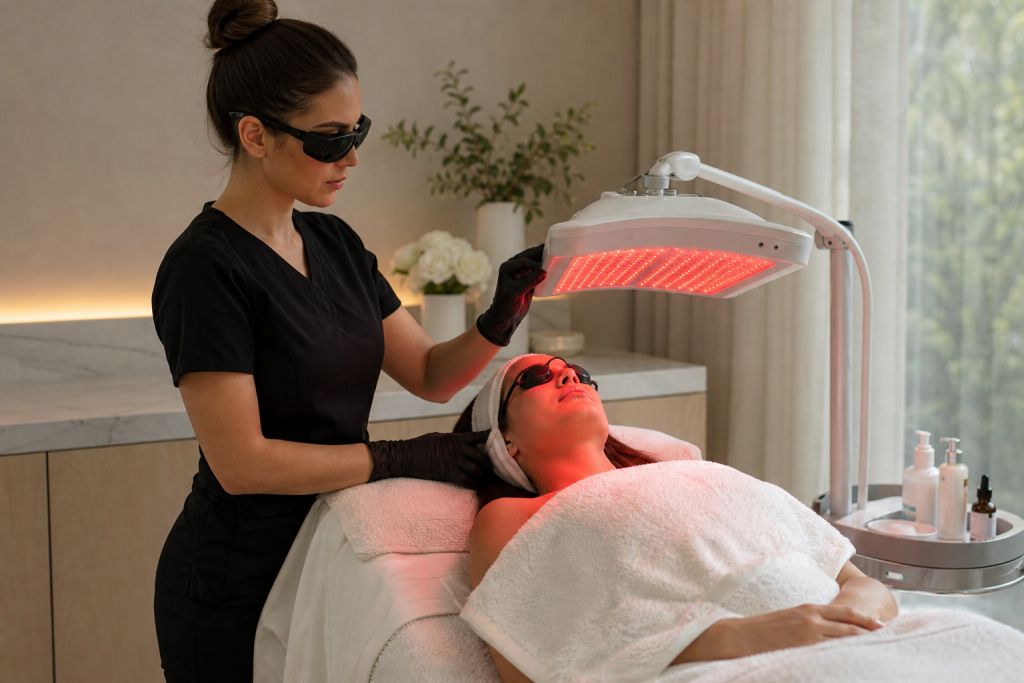
- Eye protection and time/distance controls reduce risk during treatments.
What the evidence supports and what it doesn’t
Clinical reviews and an evidence-based consensus show that photobiomodulation can produce short-term improvements in wound healing, inflammation markers, and subjective skin appearance in some studies, but results are heterogeneous and depend on wavelength, dose, and treatment schedule [2]. Therefore, expect modest, short-term cosmetic improvements from a professional LED add-on and multiple sessions for cumulative results rather than immediate, dramatic change. This aligns with American Academy of Dermatology guidance to temper claims and to advise clients about realistic benefits [1].
Confirmed facts:
- Short-term safety in clinical settings is supported by recent reviews when treatments follow established parameters and protections [2].
- Professional settings should screen for contraindications, including use of photosensitizing medications and certain medical conditions [1].
- Regulatory oversight focuses on device safety and labeling; cosmetic claims are monitored by the FDA [3].
Common in-spa LED add-on uses and realistic expectations
At Asal Skin Lounge and similar studios, LED add-ons are commonly paired with deep-cleansing or hydrating facials. Typical goals clients report include:
- Reduced redness immediately after treatment sessions (variable)
- Smoother texture and improved glow after multiple sessions
- Support for post-extraction calming or to complement acne-management facials (when appropriate)
However, LED should not be presented as a medically proven cure for scarring, severe inflammatory skin disease, or active infections. If you have a chronic skin condition, consult a dermatologist before relying on LED as a primary therapy [1][2].
Who should consult a dermatologist before booking an LED add-on
Discuss LED light therapy facial add-on safety Woodland Hills clients with any of the following situations should consult their dermatologist first:
- Current or recent use of photosensitizing medications (for example, some antibiotics or acne drugs) [1]
- History of photosensitivity disorders or lupus
- Recent isotretinoin use within the past six months or as advised by your prescribing clinician
- Pregnancy or breastfeeding — discuss with your health provider
- Active skin infections, open wounds, or uncontrolled inflammatory skin disease
These precautions are based on dermatologist guidance and the clinical consensus emphasizing patient selection to reduce risk [1][2].
Practical safety steps your esthetician should take
- Complete a treatment intake and medication screen before booking the LED add-on.
- Provide and require proper eye protection during the session.
- Use devices cleared for cosmetic use and follow manufacturer dosing recommendations.
- Start with conservative exposure times and schedule follow-up sessions based on response.
- Document consent and aftercare instructions, including sun protection and signs to report.
Comparing LED add-ons with other professional facial technologies
| Feature | LED add-on | High frequency | Galvanic/infusion | At-home LED devices |
|---|---|---|---|---|
| Primary effect | Photobiomodulation; calming, potential texture improvement | Antibacterial, circulatory boost | Product infusion, ionic delivery | Lower-dose photobiomodulation |
| Operator control | High — time, distance, wavelength control in pro devices | High — practitioner controls intensity | High — technician controls settings and serums | Low — device limitations and user technique vary |
| When to choose | As adjunct to facials for calming or glow | For acne-prone or congested skin adjunct | When enhanced product delivery is priority | For maintenance; discuss with pro first |
| Safety considerations | Photosensitivity screening, eye protection | Not for open wounds; avoid if photosensitive | Avoid if irritated or actively inflamed | Lower dose but still screen for meds/conditions |
Availability and cost considerations
Availability of LED add-ons in Woodland Hills varies by studio and device model. Ask your provider about the specific wavelength(s) used (commonly red ~630–660 nm, near-infrared ~810–850 nm), session length, and recommended number of sessions. The FDA’s cosmetic and device guidance affects labeling and marketing; clinics must avoid unapproved medical claims about treating disease [3]. For current pricing and scheduling at Asal Skin Lounge, contact the studio directly.
Practical next steps before booking
- Tell your esthetician about all medications, recent prescriptions, and medical history.
- Ask whether the device and operator follow manufacturer instructions and provide eye protection.
- Request a patch or short session if you have particularly reactive or sensitive skin.
- If you have a chronic or severe skin condition, consult a dermatologist first and bring their clearance if provided [1][2].
How Asal Skin Lounge implements LED add-ons in Woodland Hills
At Asal Skin Lounge, our approach follows updated safety principles. We screen clients at booking, require eye protection, and combine LED with customized facials only when appropriate. If screening raises concerns, we advise a dermatologist consultation prior to adding LED. These measures reflect current recommendations from dermatology authorities and device safety guidance as of 2026-09-01 [1][2][3].
Key takeaway
LED light therapy facial add-on safety Woodland Hills clients depends on careful screening, conservative dosing, and realistic expectations. As of 2026-09-01, short-term safety in supervised settings is supported, but client selection and device use matter for both safety and likely benefit [1][2][3].
FAQs
Q: Is LED therapy painful?
A: No. Professional LED sessions are typically painless; you may feel mild warmth. Painful reactions are uncommon when treatments follow device recommendations and proper screening.
Q: How soon will I see results?
A: Some clients notice transient improvements in redness or glow after a session, but consistent changes usually require multiple sessions and complementary skincare. Results vary by skin type and goals.
Q: Can I combine LED with chemical exfoliation or retinoids?
A: Combining treatments requires care. Strong chemical peels or recent isotretinoin use may increase risk; disclose all topical and oral medications so your provider can schedule and sequence safely [1].
Q: Are at-home LED devices as effective as professional in-spa systems?
A: At-home devices often use lower power and deliver lower doses per session. They may help maintenance but are not direct substitutes for higher-output professional devices used by trained estheticians. Follow manufacturer and professional guidance [2].
If you have questions about LED add-ons or wish to schedule a customized facial with optional LED in Woodland Hills, book online or call Asal Skin Lounge at +1 (747) 746-3818. Our team will review contraindications, explain expected outcomes, and recommend the safest plan for your skin.


Frequently asked questions
Is LED light therapy safe for everyone?
LED is generally well tolerated short term in supervised professional settings, but not everyone should use it. People taking photosensitizing medications, those with photosensitivity disorders, recent isotretinoin users, pregnant clients, or those with active skin infections should consult a dermatologist before treatment [1][2].
How long are LED add-on sessions and how many will I need?
Session length and recommended number of visits vary by device and treatment goal. Expect short add-on sessions during a facial and multiple sessions over weeks for cumulative effects. Your esthetician will recommend a schedule based on your skin and objectives.
Do I need eye protection during an LED facial add-on?
Yes. Professional treatments require eye protection for both client and operator when necessary to reduce retinal exposure. Proper shielding is a standard safety step [1].
Should I stop my topical skincare before an LED add-on?
Discuss your current topical regimen with your esthetician. Some active ingredients may increase photosensitivity or irritation. Your provider may advise temporary adjustments or patch testing to reduce risk.
Need practical help?
Asal Skin Lounge — Contact us to schedule service or request a quote. Service area: Woodland Hills.
Topic in context

Sources and further reading
These links were validated and checked when possible when this article was created; some publishers limit automated requests. Facts, guidance, prices, regulations, and availability can change.
- Is red light therapy right for your skin? — American Academy of Dermatology (AAD) (2024-09-01) — primary source
- Evidence-based consensus on the clinical application of photobiomodulation — Journal of the American Academy of Dermatology / ScienceDirect (2025-08-01)
- Cosmetics — U.S. Food and Drug Administration (FDA) (2026-08-30) — primary source