
LED light therapy facial add-on safety — 2026 Guide
LED light therapy facial add-on safety: As of 2026, LED light therapy facial add-on safety explained for Woodland Hills clients: benefits, risks, dosing eviden…
View article sections
- 01Quick summary — what clients should know
- 02What is photobiomodulation (LED) and why salons offer it
- 03Official announcements, confirmed facts, and independent reporting
- 04What the evidence and guidance mean for LED light therapy facial add-on safety
- 05Common safety considerations and practical risks
- 06What to ask your provider about LED light therapy facial add-on safety
- 07How LED add-ons compare with other facial technologies
- 08Professional devices vs at-home LED units
- 09Practical pre- and post-care tips
- 10Availability, session planning, and cost notes
- 11When to consult a medical professional
- 12Next steps for Woodland Hills clients
- 13What we recommend when booking
- 14Confirmed limits and realistic expectations
- 15Frequently asked questions
- 16Additional FAQs for booking and safety
- 17Sources and how they were used
- 18Related guides and resources
What changed (and why it matters): On September 10, 2026, regulatory guidance and recent systematic reviews clarified that consistent dosing and device data are central to safe and effective photobiomodulation for skin and wounds. This affects anyone evaluating LED light therapy facial add-on safety before a professional appointment in Woodland Hills and nearby communities.
Quick summary — what clients should know
Confirmed facts: The U.S. Food and Drug Administration issued draft guidance emphasizing clinical dosimetry and device performance data for photobiomodulation (PBM) devices, while recent systematic reviews highlighted that trial results vary mainly because of inconsistent dosing and study methods [3][1].
What is photobiomodulation (LED) and why salons offer it
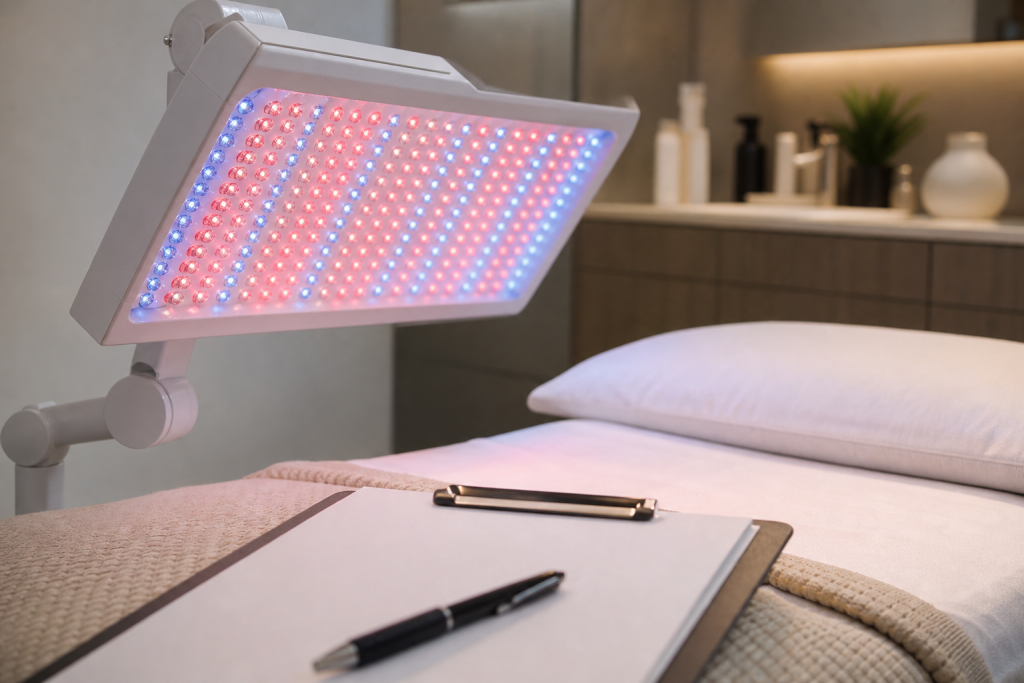
Photobiomodulation—commonly called LED light therapy—uses narrow bands of visible red, near-infrared, or blue light to deliver energy to superficial skin tissues. Providers add short LED sessions to facials because devices are noninvasive, quick, and integrate easily into a multi-step professional treatment.
LED light therapy facial add-on safety — evidence in a nutshell
Independent systematic reviews and consensus statements show that PBM can be safe when devices are used with appropriate dosimetry, but the strength of evidence for specific skin outcomes varies by wavelength, dose, and clinical protocol [1][2]. The primary regulatory emphasis through 2026 is on controlled device testing and transparent reporting of output and energy delivered to tissue [3].
Official announcements, confirmed facts, and independent reporting
- Official announcement: The FDA released draft guidance for PBM devices, focusing on premarket data, device performance, and dosimetry expectations (official guidance; see source) [3].
- Independent reporting / evidence: A 2026 systematic review of randomized trials underlined that clinical outcomes for wound healing and skin endpoints depend heavily on dose parameters and consistent trial design [1].
- Consensus guidance: An evidence-based consensus on clinical PBM application provides clinician-focused recommendations on wavelength ranges, dosing concepts, and cautions that inform professional practice [2].
What the evidence and guidance mean for LED light therapy facial add-on safety
Analysis: Taken together, these sources mean salons and clients should expect clear information about the device (wavelengths, power output, session duration, and energy delivered). Where that data is missing, claims about benefit are harder to confirm [1][2][3].
Estimates: Modern, well-characterized LED systems used by trained professionals generally show low rates of adverse effects in trials, but outcomes depend on correct dosing and client selection [1][2].
Common safety considerations and practical risks
General educational points (not personalized medical advice):
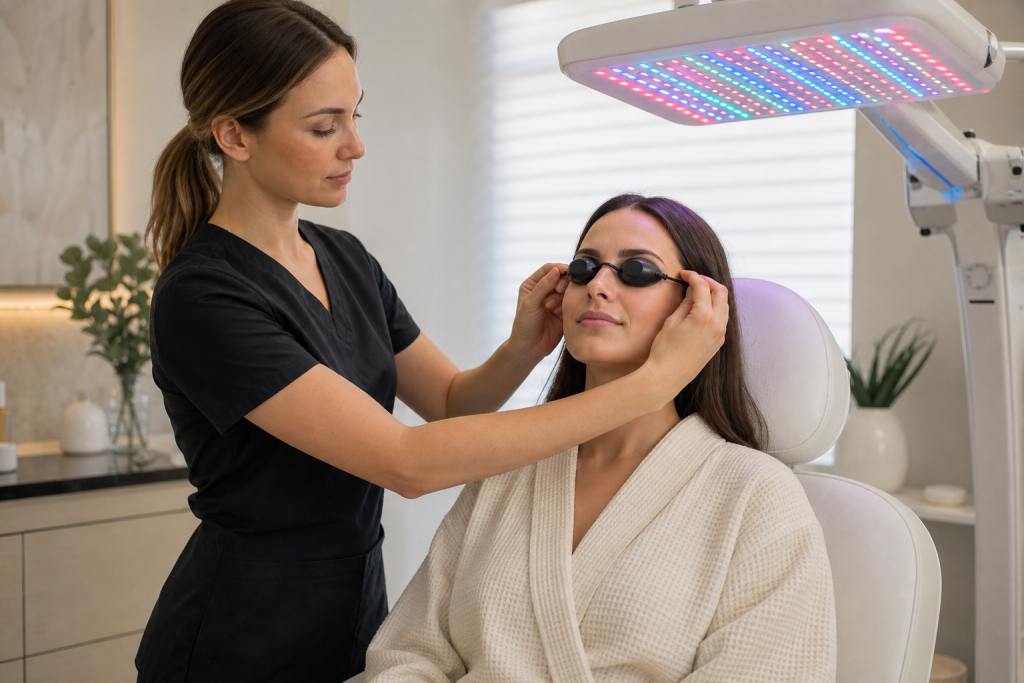
- Eye protection: Direct eye exposure should be avoided. Professional settings supply goggles for clients and operators.
- Photosensitizing medications and skincare: Some topical or systemic agents increase light sensitivity. Disclose all medications and active topical prescriptions when you book.
- Active skin injury or infection: Avoid treating open wounds or unstable infections without medical clearance.
- Temperature and skin irritation: LED panels produce minimal heat, but immediate post-treatment redness or irritation can occur—especially with aggressive concurrent exfoliation or strong topical actives.
These safety points align with consensus clinical guidance and device-focused recommendations emphasizing clear labeling and contraindication screening [2][3].
What to ask your provider about LED light therapy facial add-on safety
Before adding LED to a facial, ask the salon or clinician these specific, practical questions:
- Which wavelengths does your device use (red, near-infrared, blue)?
- What is the recommended session time and how much energy is delivered (if known)?
- Do you provide eye protection and a written contraindication checklist?
- How do you modify protocols for sensitive skin or medication use?
- Can you combine LED with the other steps in my facial safely?
Requesting these details helps you judge LED light therapy facial add-on safety and whether the salon follows recommendations to document device output and protocol adjustments [3].
How LED add-ons compare with other facial technologies
| Feature | LED light therapy | High frequency | Galvanic deep infusion |
|---|---|---|---|
| Mechanism | Light energy (photobiomodulation) | Oscillating current, ozone generation at electrode | Low electrical current to drive products into skin |
| Typical session time | 5–20 minutes (add-on) | 5–15 minutes | 5–20 minutes |
| Evidence strength | Moderate but dose-dependent; clearer when device parameters reported [1][2] | Limited, largely experiential and small studies | Limited; benefits depend on formulation and protocol |
| Common safety notes | Requires eye protection; check for photosensitizers [2] | Avoid broken skin; may cause mild irritation | Avoid open wounds and active infections |
Professional devices vs at-home LED units
Analysis: The main differences are output, dosimetry control, and documented performance. Professional systems usually provide consistent energy delivery and documented protocols; many at-home devices are lower-power and intended for maintenance rather than clinical treatment. From a safety standpoint, lower power can reduce risk but also limits potential effect. Always follow product instructions and consult professionals for concerns.
Practical pre- and post-care tips
- Before treatment: Share medications, recent procedures, and topical prescriptions with your esthetician.
- During treatment: Use provided eye protection and avoid direct staring into LEDs.
- After treatment: Follow your provider’s product and sunscreen advice; if irritation develops, contact the salon and your healthcare provider if severe.
Availability, session planning, and cost notes
Estimates: Session length for LED add-ons is typically short and fits into most facial appointments. Pricing and package options vary by studio and device. Ask your provider about session duration, how LED integrates into your chosen facial, and whether a series is recommended. The FDA guidance and clinical reviews do not mandate single pricing models but do emphasize documented protocols and device descriptions for safety and reproducibility [3][1].
When to consult a medical professional
General educational guidance: If you have a history of photosensitivity, are taking photosensitizing medication, have active skin infections, or have a prior cancer diagnosis affecting the treatment area, consult your physician before a PBM session. The consensus literature encourages clinician screening for these concerns [2].
Next steps for Woodland Hills clients
Asal Skin Lounge offers customized facials in Woodland Hills and integrates advanced, evidence-aware add-ons based on client needs. If you’re considering an LED light therapy facial add-on, book a consultation where we review your medications, skin history, and treatment goals, and provide device details and safety measures specific to your session.
What we recommend when booking
- Request the device specs or at least wavelength(s) and session time.
- Disclose medications and recent dermatologic treatments ahead of time.
- Ask that the esthetician document informed consent and contraindication screening.
- Follow post-care instructions about topical actives and sun protection.
Confirmed limits and realistic expectations
Confirmed facts: Systematic reviews and consensus documents show PBM outcomes are heterogeneous across studies. That heterogeneity is often due to inconsistent dosing, varying devices, and small trial sizes, rather than a universal failure of the modality [1][2].
Analysis: In practice, LED add-ons are best understood as low-risk, complementary tools when used appropriately, not as replacements for clinical treatments or medical care.
Frequently asked questions
Is LED light therapy painful?
Generally no—LED treatments are noninvasive and painless for most clients. Some may experience mild warmth or temporary redness. Discuss discomfort thresholds with your esthetician.
Can I combine LED with exfoliation or peels?
Often yes, but protocols vary. Combining aggressive exfoliation or strong chemical peels with LED on the same day may increase irritation risk. Your provider should tailor timing and intensity based on your skin and products used [2].
How many sessions will I need?
There is no one-size-fits-all answer. Some protocols use single-session maintenance; others recommend a short series. Evidence shows that dosing consistency matters; your clinician should explain the planned regimen and expected follow-up [1].
Are at-home LED devices safe?
Many at-home devices are lower-power and safe when used per instructions, but they deliver lower energy than professional units. For specific concerns or stronger protocols, professional treatment ensures device control and trained screening [3].
Additional FAQs for booking and safety
Should I avoid LED if I’m pregnant?
Evidence is limited. Many providers exercise caution and recommend medical consultation during pregnancy. Disclose pregnancy status at booking so the esthetician can advise appropriately.
What if I’m using prescription topical retinoids?
Your esthetician may ask you to pause certain topical actives before or after treatment to reduce irritation. Always follow personalized instructions from your provider.
How does the FDA guidance affect salons?
Official announcement: The FDA draft guidance encourages transparent device data and robust premarket submissions for PBM devices, raising expectations that providers should know and document device performance and dosimetry for clinical use [3].
Sources and how they were used
- Systematic review of randomized trials on clinical dosimetry and efficacy for PBM informed the emphasis on dose and study quality [1].
- Evidence-based consensus on clinical PBM application supplied clinician-facing recommendations on wavelengths and cautions [2].
- FDA draft guidance framed regulatory expectations for device performance, premarket data, and labeling as of 2026 (official announcement) [3].
Labels used in this article: “Official announcement” for FDA draft guidance; “Confirmed facts” and “Independent reporting” for peer-reviewed analyses; “Analysis” and “Estimates” mark interpretation or nondefinitive statements.
If you live in Woodland Hills, Tarzana, Encino, West Hills, Canoga Park, Calabasas, or nearby communities and want a clear, personalized discussion about LED light therapy facial add-on safety, contact Asal Skin Lounge to schedule a consultation. Book online or call +1 (747) 746-3818.


Frequently asked questions
What is LED light therapy and how is it used as a facial add-on?
LED light therapy, or photobiomodulation, uses narrow bands of visible light (commonly red, near-infrared, or blue) to deliver energy to skin cells. In a facial, it is typically a short add-on session incorporated into a customized treatment. Providers select wavelengths and session length based on the facial protocol and client needs.
Is LED light therapy facial add-on safety well-established?
Evidence shows LED treatments can be safe when device output and dosing are controlled, but study results vary when these details are inconsistent. Regulatory guidance through 2026 stresses the importance of documented dosimetry and device performance for safety and reproducibility [1][2][3].
Are there any contraindications I should tell my esthetician about?
Yes—disclose photosensitizing medications, active skin infections or open wounds, recent dermatologic procedures, and pregnancy status. Providers screen for these factors and modify or decline treatment when appropriate, following consensus recommendations [2].
How should I choose between professional LED and at-home devices?
Professional devices generally offer controlled output and documented protocols, while at-home units are typically lower-power and intended for maintenance. For safety and stronger protocols, a professional consultation helps determine the right option and ensures appropriate screening and post-care guidance [3].
Will LED light therapy replace medical skin treatments?
No. LED is a complementary, noninvasive add-on used alongside professional facials and skincare. It is not a substitute for medical treatments prescribed by a physician. Discuss your goals with both your esthetician and healthcare provider when appropriate.
Need practical help?
Asal Skin Lounge — Contact us to schedule service or request a quote. Service area: Woodland Hills.
Topic in context
Sources and further reading
These links were validated and checked when possible when this article was created; some publishers limit automated requests. Facts, guidance, prices, regulations, and availability can change.
- Clinical dosimetry and efficacy of LED photobiomodulation for chronic lower-limb wound healing: a systematic review of randomized trials — Lasers in Medical Science / PubMed (NCBI) (2026-06-19)
- Evidence-based consensus on the clinical application of photobiomodulation — PubMed (NCBI) / Journal article
- Photobiomodulation (PBM) Devices – Premarket Notification [510(k)] Submissions (draft guidance) — U.S. Food and Drug Administration (FDA) — primary source