
Safe Facials During Pregnancy: Woodland Hills Guide
facials during pregnancy: How to approach facials during pregnancy and breastfeeding in Woodland Hills—evidence, what to avoid, safe add-ons, and appointment t…
View article sections
- 01Quick summary: what changed and why it matters
- 02Opening: facials during pregnancy — what to expect (first 100 words)
- 03Official guidance and evidence (confirmed facts)
- 04Electrical modalities and device‑based add‑ons: analysis of recent reviews
- 05Common facial services: safety overview and local recommendations
- 06How Asal Skin Lounge approaches facials during pregnancy
- 07Practical questions to ask before you book
- 08Alternatives if you want to avoid device add‑ons
- 09Costs, scheduling, and availability (estimates and next steps)
- 10Confirmed facts vs. analysis
- 11Practical checklist before your facial during pregnancy
- 12Local comparisons: professional facials vs. at‑home care for pregnant clients
- 13Next steps and how to book
- 14References and sourcing
- 15Reader FAQs
- 16Related guides and resources
- 17Frequently asked questions
- 18Need practical help?
Updated 2026-10-27: More clients are asking whether professional facial add-ons like LED, high‑frequency, and galvanic treatments are safe while pregnant or nursing. Recent clinical reviews and electrotherapy guidance emphasize limited high‑quality safety data and frequent manufacturer contraindications for electrical modalities; that matters if you’re scheduling facials during pregnancy in Woodland Hills because informed consent and tailored options reduce risk and worry [3][4].
This article summarizes confirmed guidance, independent analysis, likely risks, and practical next steps so clients at Asal Skin Lounge can choose safe, effective appointments.
For a safe, relaxing facial adapted to pregnancy or breastfeeding, contact Asal Skin Lounge in Woodland Hills to book a consultation online or call +1 (747) 746-3818.
Quick summary: what changed and why it matters
On 2026-10-27, updated professional reviews and electrotherapy guidance reinforced that high‑quality evidence about safety of many in‑spa electrical modalities in pregnancy and lactation remains limited, and manufacturers commonly list pregnancy as a contraindication for devices such as microcurrent and some LED systems [3][4].
Confirmed facts and official guidance to keep in mind:
- Major dermatology and consumer-safety organizations recommend caution with certain topical and device-based treatments during pregnancy and breastfeeding [1][2].
- There is limited direct safety research on many salon electrical modalities in pregnant or lactating people; guidance therefore emphasizes individual risk–benefit assessment and conservative choices [3][4].
Opening: facials during pregnancy — what to expect (first 100 words)
If you’re pregnant or breastfeeding, asking about facials during pregnancy is essential. Many basic facials—cleansing, gentle exfoliation, massage, hydration, and extractions—are commonly adjusted rather than canceled. However, certain actives (for example, prescription retinoids) and some device‑based add‑ons may be advised against or require discussion with your obstetric provider. As of 2026-10-27, professional associations and regulators recommend a cautious, ingredient‑aware approach and note limited clinical data for several electrical treatments [1][2][3].
Official guidance and evidence (confirmed facts)
Topline official sources emphasize caution but do not categorically ban all cosmetic procedures in pregnancy:
- The American Academy of Dermatology (AAD) advises avoiding prescription retinoids and consulting your clinician about high‑concentration chemical peels and prescription treatments; many over‑the‑counter cleansers, moisturizers, and sunscreens are considered acceptable when used correctly [1].
- The U.S. Food and Drug Administration (FDA) notes that cosmetics are regulated differently than medicines and recommends discussing medical or procedural concerns with a healthcare professional while using pregnancy‑appropriate products [2].
These are official recommendations based on existing safety data and regulatory frameworks, not new clinical trials [1][2].
Electrical modalities and device‑based add‑ons: analysis of recent reviews
Recent clinical reviews and electrotherapy practice guidance have concluded there is limited high‑quality evidence about safety of many device‑based facial add‑ons (for example, microcurrent, galvanic, some LED and radiofrequency devices) in pregnancy and lactation. Furthermore, many device manufacturers list pregnancy as a contraindication in their instructions for use [3][4].
What that means in practice:
- Manufacturers’ contraindications are legally and ethically important: estheticians generally avoid procedures that device makers say are contraindicated for pregnancy [4].
- Limited research does not necessarily mean harm, but it does mean practitioners and clients should adopt a conservative approach and prioritize low‑risk alternatives when possible [3].
Common facial services: safety overview and local recommendations
Below is a practical assessment of common facial elements and add‑ons, labeled by evidence and recommended action for clients booking facials during pregnancy.
| Service / Add‑on | Evidence & official notes | Practical recommendation for Woodland Hills clients |
|---|---|---|
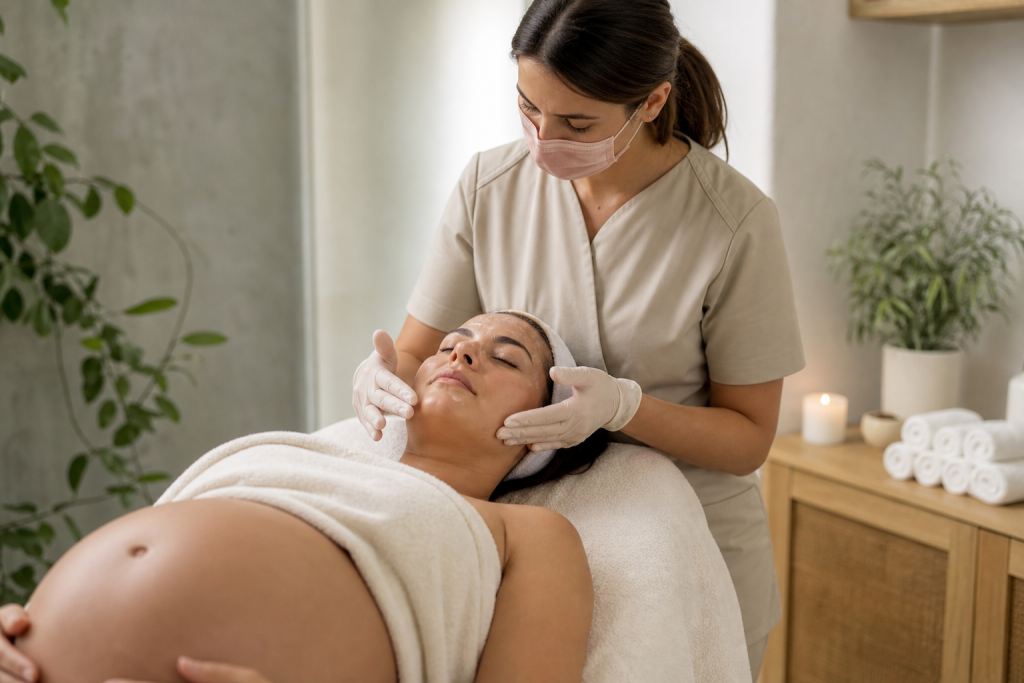
| Basic customized facial (cleansing, steam, gentle manual extractions) | Generally considered low risk when gentle techniques and pregnancy‑safe products are used [1][2]. | Acceptable with tailored product choices and communication—book at Asal Skin Lounge and tell your esthetician you are pregnant. |
| Topical chemical peels (glycolic, lactic, low‑strength salicylic) | Evidence varies; AAD recommends caution with higher‑strength peels and salicylic acid at prescription strengths [1]. | Use low‑strength superficial peels only after consultation; avoid high‑strength or medical peels without OB guidance. |
| Retinoids/topical prescription retinoids | Official guidance: avoid prescription retinoids during pregnancy [1][2]. | Do not include retinoid‑based treatments in your facial while pregnant or breastfeeding; bring your medication list to your appointment. |
| Microdermabrasion & aggressive mechanical resurfacing | Limited data; superficial microdermabrasion is generally lower risk than deep resurfacing but should be used cautiously [3]. | Prefer gentler exfoliation methods and avoid aggressive resurfacing procedures during pregnancy. |
| LED light therapy | Evidence is limited and manufacturers often list pregnancy as a contraindication; reviews call for individualized assessment [3][4]. | Discuss device model and manufacturer’s guidance with your esthetician; many salons postpone LED add‑ons during pregnancy. |
| High‑frequency and galvanic treatments (electrotherapy) | Electrotherapy guidance lists pregnancy among contraindications for many devices; high‑quality safety data are scarce [3][4]. | Generally avoided during pregnancy and lactation at Asal Skin Lounge unless a device explicitly indicates safety and your clinician approves. |
| Waxing (facial waxing) | Not contraindicated by pregnancy itself, but hormonal skin changes can increase sensitivity and bruising risk [1]. | Proceed with caution—choose experienced technicians and consider spot tests for sensitivity. |
Notes on breastfeeding (lactation)
The same review that covers pregnancy also evaluated lactation: evidence remains limited for many procedures, and decisions should weigh the exposure risk from topicals as well as device safety; consult your lactation or medical provider for medication‑related questions [3].
How Asal Skin Lounge approaches facials during pregnancy
At our Woodland Hills studio we follow a conservative, documented process:
- Intake screening—discuss pregnancy status, due date, medications, and any prior skin conditions.
- Product selection—avoid prescription retinoids and high‑dose actives that are flagged by dermatology groups or regulators [1][2].
- Device policy—decline add‑ons when a device or manufacturer lists pregnancy as a contraindication; consider low‑risk alternatives.
- Coordination—encourage clients to consult their obstetric provider if uncertain about a medication, medical device, or complex procedure.
This approach aligns with professional risk–benefit frameworks that recommend individualized decisions when data are limited [3].
Practical questions to ask before you book
Bring these questions to your booking call or consultation:
- Do you have experience with pregnant clients and what adjustments do you make?
- Which specific products and concentrations will you use, and are any contraindicated in pregnancy or breastfeeding? (Request ingredient lists.)
- If you use device add‑ons, what is the manufacturer’s pregnancy guidance for that device? (Ask for model name.)
- Do you keep a record of my consent and modifications for pregnancy-related adjustments?
Alternatives if you want to avoid device add‑ons
If you prefer to skip electrical or uncertain procedures, consider these lower‑risk options commonly available at our studio:
- Hydrating facials focused on barrier repair and gentle massage
- Enzyme or low‑strength AHA exfoliation under supervision
- Manual extractions performed gently to reduce inflammation
- Spa‑grade calming masks and targeted serums that avoid retinoids
Costs, scheduling, and availability (estimates and next steps)
Service availability and add‑on policies vary by appointment time and device scheduling. As of 2026-10-27, our recommended next step is to book a consultation so we can confirm which treatments and add‑ons are appropriate for your stage of pregnancy or lactation. For precise pricing and to reserve a prenatal‑friendly appointment at Asal Skin Lounge, book online or call +1 (747) 746-3818.
Confirmed facts vs. analysis
- Confirmed facts: AAD and FDA guidance on topical medication avoidance and consumer counseling are official recommendations; manufacturers sometimes contraindicate pregnancy for certain devices [1][2][4].
- Independent analysis: Recent clinical reviews conclude that high‑quality evidence on many device modalities in pregnancy and lactation is limited; therefore, professional judgment and conservative choices are recommended [3].
Practical checklist before your facial during pregnancy
- Tell us you are pregnant or breastfeeding when booking.
- Bring a list of current medications and topical prescriptions.
- Ask which products and devices will be used and request alternatives if needed.
- Consider a short consultation appointment to plan modifications.
Local comparisons: professional facials vs. at‑home care for pregnant clients
Professional facials offer customized assessment, sterile techniques, and access to medical‑grade products. In contrast, at‑home care gives you control over product selection but lacks professional screening and device oversight. For pregnant clients, an in‑studio consultation helps ensure manufacturer contraindications and product safety are respected while still delivering relaxation and visible skin support [1][3][4].
Next steps and how to book
If you’re in Woodland Hills, Tarzana, Encino, West Hills, Canoga Park, Calabasas, or nearby, schedule a prenatal‑friendly consultation so we can design a safe facial plan tailored to your needs. For appointments, book online or call +1 (747) 746-3818. If you have medical questions about medications or specific medical devices during pregnancy or lactation, consult your obstetric provider first.
References and sourcing
Key sources used in this article:
- Dermatologist‑approved pregnancy skin care — American Academy of Dermatology (AAD), 2025 [1].
- Cosmetics & Pregnancy — U.S. Food and Drug Administration (FDA), 2024 [2].
- Cosmetic Dermatology in Pregnancy and Lactation: risk–benefit framework — International Journal of Dermatology / Wiley, 2026 (review/analysis) [3].
- Face and Body Electrotherapy — contraindications and safety guidance (SQA), 2026 [4].
Reader FAQs
Can I get a facial while pregnant?
Yes—many gentle, customized facials are acceptable during pregnancy when your esthetician avoids contraindicated actives (for example, prescription retinoids) and follows manufacturer guidance for devices. Always tell your provider you are pregnant so adaptations can be made [1][2].
Are LED facials safe during pregnancy?
Evidence is limited and some device manufacturers list pregnancy as a contraindication. Discuss the specific LED device and its manufacturer’s guidance with your esthetician; many salons recommend postponing LED add‑ons during pregnancy [3][4].
Can I get waxing or eyebrow services while pregnant?
Yes, but hormonal skin changes can increase sensitivity. Choose an experienced technician, and consider a small patch test if you have increased tenderness or bruising [1].
Should I consult my obstetrician before a facial?
Consult your obstetrician if you’re using prescription medications, have medical concerns, or plan to undergo stronger peels or device‑based treatments. For most gentle facials, consultation with your esthetician and disclosure of medications is sufficient [1][2][3].
What if I’m breastfeeding—are the recommendations different?
Recommendations are similar: avoid certain topicals with known systemic absorption concerns and be cautious with devices where safety data are limited. Discuss topical medications and lactation with your medical provider [3].


Frequently asked questions
Can I get a facial while pregnant?
Yes—many gentle, customized facials are appropriate during pregnancy when estheticians avoid contraindicated actives and adjust techniques. Always disclose your pregnancy and any medications before the appointment [1][2].
Are LED or high‑frequency treatments safe during pregnancy?
Safety data are limited and many device manufacturers list pregnancy as a contraindication. Most guidance recommends individual assessment and conservative choices; many salons postpone such add‑ons during pregnancy [3][4].
Which topical ingredients should I avoid during pregnancy?
Official dermatology guidance recommends avoiding prescription retinoids during pregnancy and being cautious with high‑strength peels and certain prescription actives. Discuss product ingredients with your esthetician and obstetric provider [1][2].
Should I talk to my OB before booking a facial?
If you use prescription medications, plan device‑based treatments, or have medical concerns, consult your obstetric provider. For most gentle facials, a thorough esthetician consultation and disclosure of medications is sufficient [1][3].
Need practical help?
Asal Skin Lounge — Contact us to schedule service or request a quote. Service area: Woodland Hills.
Topic in context

Sources and further reading
These links were validated and checked when possible when this article was created; some publishers limit automated requests. Facts, guidance, prices, regulations, and availability can change.
- Dermatologist‑approved pregnancy skin care — American Academy of Dermatology (AAD) (2025-10-01) — primary source
- Cosmetics & Pregnancy — U.S. Food and Drug Administration (FDA) (2024-06-12) — primary source
- Cosmetic Dermatology in Pregnancy and Lactation: A Risk–Benefit Framework for Clinical Practice — International Journal of Dermatology / Wiley (2026-08-01) — primary source
- Face and Body Electrotherapy — contraindications and safety (guidance) — SQA / electrotherapy practice guidance (2026-06-15)