
PFAS cosmetics Woodland Hills: MoCRA guidance for local clients
PFAS cosmetics Woodland Hills: PFAS cosmetics Woodland Hills — What the FDA's MoCRA update (Oct 29, 2026) and its PFAS report mean for clients choosing safe pr…

View article sections
- 01PFAS cosmetics Woodland Hills
- 02Quick summary for Woodland Hills clients (opening 100 words)
- 03Confirmed facts, official announcements, and key dates
- 04What the FDA’s PFAS report says (plain-language summary)
- 05Practical implications for facials, add-ons, and retail at Asal Skin Lounge
- 06Which product types show higher likelihood of PFAS presence?
- 07How Asal Skin Lounge evaluates products (what we do differently)
- 08How to ask the right questions before booking or buying
- 09Testing, cost, and availability
- 10Alternatives and safer product choices
- 11What we recommend you do next (Woodland Hills clients)
- 12Local context and appointment types at Asal Skin Lounge
- 13Sources and how they were used
- 14Reader FAQs
- 15Final note and next steps
- 16Related guides and resources
- 17Frequently asked questions
- 18Need practical help?
PFAS cosmetics Woodland Hills
This dated, source-based update separates verified details, limitations, and practical next steps.
PFAS cosmetics Woodland Hills should be evaluated against the cited evidence and its publication date.
What changed: On October 29, 2026, the U.S. Food & Drug Administration updated its Modernization of Cosmetics Regulation Act (MoCRA) information and continued implementing steps that affect how cosmetic ingredients are tracked and reported. This matters to Woodland Hills clients because the FDA’s MoCRA process and its December 29, 2025 PFAS report shape what manufacturers disclose and how professionals select products for facials and retail use, helping clients reduce avoidable exposure risks during treatments and at home.
Key documents to know: FDA MoCRA update (Oct 29, 2026) and the FDA report on PFAS in cosmetics (Dec 29, 2025) — both affect product oversight and risk information available to estheticians and consumers [1][2].
Quick summary for Woodland Hills clients (opening 100 words)
FDA updates under MoCRA on October 29, 2026, continue to expand oversight of the cosmetics industry and follow the agency’s PFAS-in-cosmetics report published Dec. 29, 2025. Because some long-wear and water-resistant personal-care products can contain PFAS-like chemistries, local clients should understand which product types, professional services, and retail purchases may carry higher likelihood of presence. Use this guide to weigh benefits and trade-offs when booking facials at Asal Skin Lounge in Woodland Hills and when choosing at-home maintenance products.
Confirmed facts, official announcements, and key dates
- Confirmed fact: The FDA posted a public MoCRA information update on October 29, 2026, as part of ongoing implementation of the Modernization of Cosmetics Regulation Act of 2022 [1].
- Official report: The FDA published a report titled “Report on the Use of PFAS in Cosmetic Products and Associated Risks” on December 29, 2025, which assessed evidence of PFAS in some cosmetics and discussed analytical challenges [2].
- Independent reporting/consumer guidance: Consumer Reports and similar organizations have identified PFAS-like substances among concerning ingredients to watch in some cosmetics and beauty products [3].
- As of: All regulatory and report dates and summaries are current as of November 2, 2026.
Why this matters to people booking facials and buying skincare in Woodland Hills
Esthetic services frequently involve repeated skin contact and product layering during professional facials, so ingredient transparency matters for clients seeking to limit cumulative exposure to persistent chemicals. The combination of a stricter regulatory environment under MoCRA and the FDA’s PFAS report makes it easier for practitioners to ask manufacturers for documentation and to prefer products with clearer ingredient histories [1][2].
What the FDA’s PFAS report says (plain-language summary)
Officially, the FDA report examined available data on PFAS in cosmetic products, discussed methods to detect PFAS, and described associated uncertainties and potential exposure pathways from cosmetic use. The report noted that PFAS (per- and polyfluoroalkyl substances) are a broad group of chemistries that can be persistent in the environment and in bodies, and that some formulations—especially those marketed as long-wear, transfer-resistant, or water-resistant—may be more likely to contain fluorinated ingredients [2].
Confirmed fact: the FDA report documented analytical challenges in measuring trace PFAS in complex cosmetic formulations and recommended more data and improved reporting so regulators and consumers can better understand risks [2].
Practical implications for facials, add-ons, and retail at Asal Skin Lounge
Professional facials use a mix of cleansers, serums, masks, and makeup-removal products. For most clients, the highest-importance practical steps are transparency and product selection.
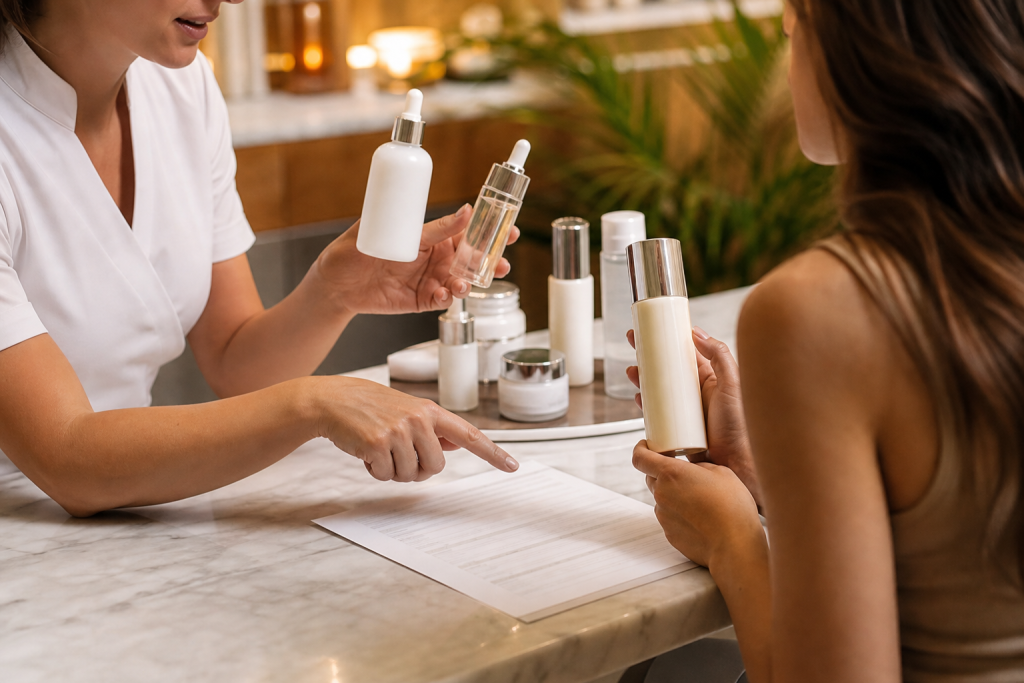
- Ask which brands and product lines your esthetician plans to use during your treatment and whether they provide full ingredient listings.
- Prefer water-based, non-long-wear formulations for treatments where possible; these product types are less often associated with PFAS chemistries than long-wear cosmetics.
- Discuss retail purchases separately—if you want PFAS-free products, request staff recommendations for low-risk alternatives.
Analysis: While the FDA report does not ban specific cosmetic ingredients, MoCRA strengthens authorities and transparency tools, so salons and product makers can expect clearer expectations and recordkeeping over time [1][2].
Which product types show higher likelihood of PFAS presence?
Independent reviews and the FDA noted that certain product forms are more likely to contain fluorinated chemistries, though presence is not universal and depends on brand and formulation. As of the FDA report and consumer research, these higher-likelihood categories include:
- Long-wear or transfer-resistant foundations, concealers, and lipsticks [2][3]
- Waterproof sunscreens and mascaras [2][3]
- Certain primers and setting products marketed for “blur,” “matte,” or “silky” finishes [3]
Confirmed fact: not all products in those categories contain PFAS; testing and ingredient disclosure are necessary to confirm presence or absence [2].
How Asal Skin Lounge evaluates products (what we do differently)
- We prioritize suppliers that provide full ingredient declarations and material-safety data when requested.
- We favor water-based and targeted active formulations for in-spa treatments to minimize unnecessary persistent chemistries in repeated-contact treatments.
- When clients request PFAS-free retail options, we compile ingredient lists and select alternatives with simpler, transparent formulas.
Estimate: For most clients, switching to transparent, non-long-wear product lines reduces the probability of PFAS exposure from daily cosmetics use. However, testing every product for PFAS is expensive and not yet common in the retail beauty chain; regulatory changes under MoCRA may increase routine reporting over time [1][2].
Comparing professional facials vs at-home care for PFAS risk
| Dimension | Professional facial (Asal Skin Lounge) | At-home products |
|---|---|---|
| Product oversight | We select products and can request supplier documentation on ingredients. | Consumers must rely on label transparency; some products lack full disclosure. |
| Exposure control | Limited to treatment duration; estheticians can limit certain product classes on request. | Daily repeated use increases cumulative exposure potential. |
| Testing likelihood | Low routine testing; salons may seek vendor assurances or certifications. | Individual testing costly; brands rarely test publicly for PFAS. |
| Best practice | Ask for products with clear ingredient lists and choose water-based options. | Prefer brands that publish ingredient transparency and independent testing. |
How to ask the right questions before booking or buying
When you book a facial or buy skincare, a few concrete questions will help staff advise you and reduce uncertainty:
- “Do you have the full INCI (ingredient) list for the products you will use today?”
- “Are any of the products marketed as long-wear, water-resistant, or transfer-resistant?”
- “Can you recommend PFAS-free retail alternatives if I’m trying to reduce exposure?”
These questions help our team tailor treatments for sensitivity, visible aging, acne-prone or dull skin, and clients concerned about persistent chemistries.
Testing, cost, and availability
Confirmed fact: analytical testing for PFAS in complex cosmetic matrices is technically possible, but costs for a single product test can range from hundreds to over a thousand dollars, depending on the lab and the suite of PFAS analyzed [2].
Estimate: Routine consumer-level testing is not practical for most purchases. Instead, rely on brand transparency, third-party certifications, and provider vetting. As regulations under MoCRA roll out, more manufacturer-provided information and reporting may become available, lowering information gaps [1].
Alternatives and safer product choices
- Prefer simple, water-based serums and moisturizers without marketing claims of extreme transfer resistance.
- Choose mineral-based sunscreens (check for formulation type) and reapply frequently rather than seeking long-lasting chemical sunscreens with unknown additives.
- When buying color cosmetics, favor brands that publish full ingredient lists and that respond to direct questions about fluorinated chemistries.
Independent reporting highlights that no single purchase eliminates all exposure; the practical goal is to reduce avoidable sources while maintaining effective skincare routines [3].
What we recommend you do next (Woodland Hills clients)
- Before your appointment, tell us if you want products that avoid long-wear or water-resistant claims so we can tailor your facial and retail suggestions.
- Request ingredient lists for products used during your treatment; our team will note any items with limited transparency and offer alternatives.
- For at-home care, ask for a short list of transparent, low-risk products compatible with your skin goals—hydration, deep cleansing, acne management, or anti-aging maintenance.
- Stay informed: as MoCRA implementation continues, ask about updated supplier documentation and whether brands used by the salon publish PFAS testing information [1][2].
Local context and appointment types at Asal Skin Lounge
Asal Skin Lounge in Woodland Hills offers customized facials, deep-cleansing treatments, hydration-focused services, LED light therapy, high-frequency, galvanic deep infusion add-ons, back treatments, waxing, and VIP experiences. For clients concerned about PFAS exposure, we can prioritize treatments and retail that reduce likelihood of contact with long-wear formulations.
Analysis: Choosing professional facials that use transparent product lines can reduce uncertainty compared with buying everyday long-wear cosmetics with incomplete ingredient disclosure. For men’s facials, post-shave care, and sensitive-skin programs, we emphasize simple, non-irritating ingredients and clear labeling.
Sources and how they were used
- Official / primary sources: FDA MoCRA information (updated Oct 29, 2026) and the FDA PFAS cosmetics report (Dec 29, 2025) — used to summarize regulatory changes, report findings, and testing challenges [1][2].
- Independent reporting and consumer guidance: Consumer Reports coverage of concerning cosmetic ingredients — used to contextualize product types that often raise PFAS concerns [3].
Reader FAQs
Q: Should I cancel my facial if I’m worried about PFAS?
A: No. Instead, tell us about your concerns when booking. We can select products without long-wear or transfer-resistant claims and provide transparent ingredient lists for your visit.
Q: Can products labeled “PFAS-free” be trusted?
A: Labels help, but they aren’t a guarantee. Look for full ingredient lists and, if available, third-party testing or clear brand statements about fluorinated chemistries. As regulations and reporting under MoCRA expand, brand transparency should improve [1][2].
Q: Are there tests I can run on my own cosmetics?
A: Consumer-level testing is not available. Accredited labs can analyze products for PFAS, but tests are technical and can be expensive. For most consumers, choosing transparent brands and avoiding high-risk product categories is the practical approach [2].
Q: Will MoCRA ban PFAS in cosmetics?
A: As of Nov 2, 2026, MoCRA increases oversight, recordkeeping, and reporting authority but does not itself ban specific ingredients. The FDA’s reporting and future rulemaking could lead to more controls over time [1][2].
Final note and next steps
Asal Skin Lounge is committed to transparent product choices and to tailoring facials for local Woodland Hills clients who want to reduce exposure to persistent chemistries while pursuing healthier-looking skin. If you’re booking for deep-cleansing, hydration, anti-aging add-ons, LED therapy, waxing, or our VIP experience, tell us your PFAS-related preference and we’ll recommend appropriate product and treatment options.
Book online or call +1 (747) 746-3818 to schedule. We’re located at 19903 Ventura Blvd #3, Woodland Hills, CA 91364.


Frequently asked questions
Should I cancel my facial if I’m worried about PFAS?
No. Instead, tell us about your concern when booking. We can choose products without long-wear or transfer-resistant claims and provide ingredient lists so your treatment aligns with your preferences.
Can products labeled “PFAS-free” be trusted?
Labels are helpful but not infallible. Prefer brands that publish full ingredient lists and independent testing. MoCRA implementation should improve transparency over time [1][2].
Are there tests I can run on my cosmetics to check for PFAS?
Accredited labs can test cosmetic products for PFAS, but testing is technical and can be costly. For most consumers, choosing transparent brands and avoiding high-risk product categories is the practical approach [2].
Will MoCRA ban PFAS in cosmetics?
As of Nov 2, 2026, MoCRA strengthens oversight and reporting but does not itself ban specific ingredients. The FDA’s PFAS report and future rulemaking could lead to further controls [1][2].
Need practical help?
Asal Skin Lounge — Contact us to schedule service or request a quote. Service area: Woodland Hills.
Topic in context
Sources and further reading
These links were validated and checked when possible when this article was created; some publishers limit automated requests. Facts, guidance, prices, regulations, and availability can change.
- Modernization of Cosmetics Regulation Act of 2022 (MoCRA) — U.S. Food & Drug Administration (FDA) (2026-10-29) — primary source
- Report on the Use of PFAS in Cosmetic Products and Associated Risks — U.S. Food & Drug Administration (FDA) (2025-12-29) — primary source
- 5 Concerning Ingredients in Cosmetics and Beauty Products — Consumer Reports