
LED facial add-on safety: Woodland Hills checklist
LED facial add-on safety: LED facial add-on safety: What Woodland Hills clients should know after the Oct 14, 2026 review — device screening, risks, and practi…
View article sections
- 01What changed and why it matters (Oct 14, 2026)
- 02Summary of the confirmed findings (as of Oct 14, 2026)
- 03How this affects in‑studio LED treatments and LED facial add-on safety
- 04Who should be screened out or receive extra precautions?
- 05Practical in‑studio checklist for LED facial add-on safety
- 06Common safety questions answered
- 07Costs, availability, and realistic expectations
- 08Next steps for Woodland Hills clients
- 09Label: analysis and estimates vs. confirmed findings
- 10Bottom line: practical checklist for clients (one-minute version)
- 11Ready to book — Asal Skin Lounge (Woodland Hills)
- 12Related guides and resources
- 13Frequently asked questions
- 14Need practical help?
- 15Topic in context
- 16Sources and further reading
LED facial add-on safety is the focus of this dated, source-based update. As a result, the article separates verified details from analysis.
What changed and why it matters (Oct 14, 2026)
On October 14, 2026 a systematic review assessing at-home and consumer light-emitting diode (LED) photobiomodulation for facial rejuvenation was published, clarifying that safety and benefits are device- and protocol-dependent. This peer-reviewed analysis updated the evidence base and is confirmed public reporting of the study findings [1]. For Woodland Hills clients and salon operators who offer LED add-ons, the review matters because it emphasizes screening, device specifications, and manufacturer protocol adherence as key to reducing risk and improving predictability [1].
Summary of the confirmed findings (as of Oct 14, 2026)
The systematic review analyzed consumer and at-home LED devices and reported that outcomes vary with wavelength, irradiance (power density), exposure time, and cumulative dosing. The review concluded that safety is generally acceptable for many devices when used according to manufacturer instructions, but risks and inconsistent benefit profiles increase when protocols, device performance, or user factors differ from those tested in trials [1].
Regulatory context: the U.S. Food and Drug Administration (FDA) has published draft guidance explaining premarket notification considerations for photobiomodulation (PBM) devices, which makes device claims and clearance status important for salons to check before offering LED add-ons [2]. Earlier randomized-trial systematic reviews also support clinical safety when devices and protocols match trial conditions, but they noted heterogeneity across studies [3].
Confirmed facts, official guidance, and independent reporting
- Confirmed fact: A systematic review was published on October 14, 2026 analyzing at-home LED photobiomodulation for facial rejuvenation [1].
- Official guidance: FDA draft guidance on PBM device submissions highlights factors regulators consider for device safety and claims; salons should review device clearance and labeling [2].
- Independent reporting: Prior systematic reviews of randomized controlled trials show clinical trial heterogeneity and generally favorable safety when device parameters are controlled [3].
How this affects in‑studio LED treatments and LED facial add-on safety
For clients booking facials in Woodland Hills, the new review underscores three practical priorities: screen clients before treatment, verify the device and its operating protocol, and document informed consent. In short, LED facial add-on safety depends less on the lights themselves and more on how the device is used and whether the client’s health factors are considered [1][2].
Key device and protocol checks
- Wavelengths: Red (around 630–660 nm) and near-infrared (around 810–850 nm) are commonly studied; each wavelength interacts differently with skin and tissue [1][3].
- Irradiance and dose: Confirm the device’s irradiance (mW/cm²) and recommended exposure time. The same dose delivered at different power densities may produce different effects and safety profiles [1].
- Manufacturer protocol: Use the manufacturer’s tested protocol or a protocol supported by peer-reviewed studies; deviate only with documented rationale and professional oversight [1][2].
- Device clearance and labeling: Check whether the device is FDA-cleared or marketed for cosmetic use; clearance does not guarantee universal safety, but absence of clearance requires extra caution [2].
Who should be screened out or receive extra precautions?
Client screening is a critical part of LED facial add-on safety. Based on the review’s emphasis and regulatory guidance, consider extra precautions or deferral for:
- Clients taking photosensitizing medications (e.g., certain tetracyclines, retinoids, or some herbal supplements). Ask clients to confirm medications and discuss with their prescriber as needed; this is an evidence-informed safety step (analysis).
- Pregnancy and breastfeeding: Most research excludes pregnant people; many providers adopt a conservative approach and defer or obtain medical clearance (analysis).
- Active infection, open wounds, uncontrolled inflammatory conditions, or lesions that have not been medically evaluated; these situations may require deferral until healed.
- History of light-triggered seizures or photosensitive epilepsy — obtain medical clearance and consider avoiding high-flash or intensely pulsed devices.
- Recent invasive facial procedures (laser, deep chemical peels, microneedling): timing matters. Follow manufacturer guidance and clinical best-practice intervals to avoid additive risks.
Label: the items above are best-practice screening points and clinical precautions derived from the evidence and regulatory context, not individualized medical advice. Clients with health concerns should consult their healthcare provider.
Practical in‑studio checklist for LED facial add-on safety
As a Woodland Hills salon offering LED add-ons, use this checklist to align with the review’s recommendations and FDA considerations:
- Verify device specifications: wavelength, irradiance, and manufacturer protocol. Document the device model and serial number in client records [1][2].
- Confirm device clearance and labeling per FDA guidance; keep device manuals and any test or maintenance records onsite [2].
- Complete a pre-treatment screening form that includes medications, recent procedures, pregnancy status, seizure history, and skin conditions.
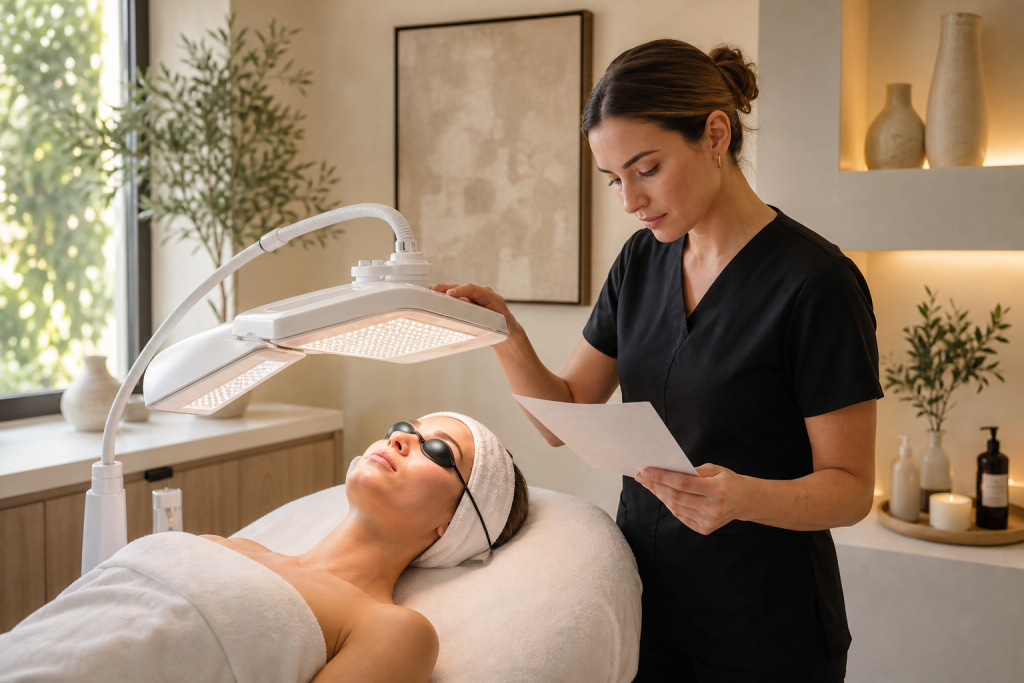
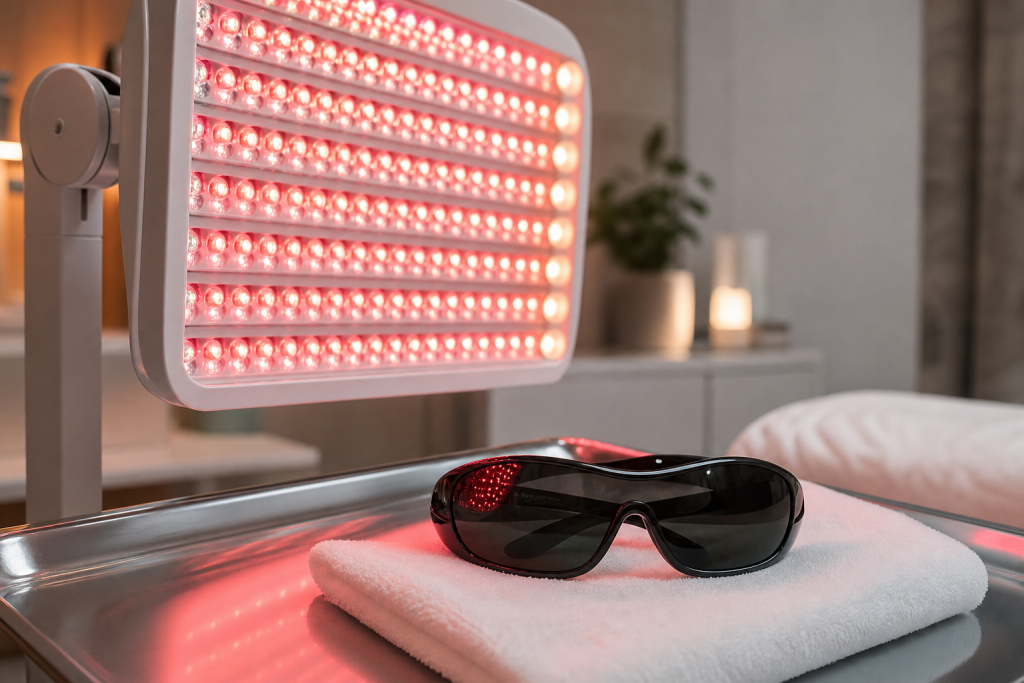
- Use eye protection appropriate for the wavelength and exposure: protective goggles for both client and operator when required by the device instructions.
- Follow manufacturer exposure times and do not increase dose without evidence-based justification and documented clinician oversight [1].
- Document consent, expected effects, possible transient reactions (e.g., redness, warming), and aftercare instructions.
- Schedule follow-up or staggered repeat sessions per protocol; avoid stacking treatments without evidence supporting the cumulative dose.
Common safety questions answered
Clients often ask whether LED lights can burn or damage skin. The systematic review confirmed that most consumer red and near-infrared LED devices used according to tested protocols have low rates of serious adverse events, but improper dose or untested device modifications can increase risk [1]. For that reason, salons should not modify LED devices or extend exposure beyond manufacturer guidance without clear, peer-reviewed support [1][2].
Comparing options: at‑home devices, professional LED panels, and other add‑ons
| Feature | At‑home LED devices | Professional in‑studio LED | High frequency / Galvanic (alternate add-ons) |
|---|---|---|---|
| Typical irradiance | Lower; longer exposure times required | Higher; shorter, controlled exposures | Different modality; not light-based |
| Regulatory status | Varies; many are consumer-grade, some cleared | Often medical or professional-grade with clearer testing | Device-dependent; different safety profile |
| Operator control | Limited — user applies themselves | High — trained clinician sets dose and monitors | High — esthetician controls intensity and duration |
| Typical use case | Maintenance between professional visits | Targeted in-facility treatments as add-on | Electrical stimulation for congestion and circulation |
In short, professional LED add-ons offer controlled dosing and trained oversight, which contributes to LED facial add-on safety compared with unsupervised at-home use, particularly when client-specific risks exist [1][3].
Costs, availability, and realistic expectations
Cost and availability vary by device and studio. Professional LED add-ons are commonly offered as short add-ons during facials; pricing reflects device quality, operator training, and time. As an estimate, add-on pricing may range across studios (estimate); confirm current pricing and packages with your provider. Remember, the systematic review does not guarantee a specific cosmetic outcome and emphasizes protocol fidelity as central to safety and reproducibility [1].
Next steps for Woodland Hills clients
- Ask the salon which LED device model they use, whether it follows a manufacturer-tested protocol, and whether the device has relevant regulatory status — these are reasonable booking questions informed by the Oct. 14, 2026 review [1][2].
- Complete the pre-treatment screening form honestly, and disclose any medications, recent procedures, or medical conditions.
- Consider a consult appointment for medical questions or if you’re unsure whether to proceed; consult your healthcare provider for medical clearance if needed.
- Choose professional in-studio LED when you want controlled dosing and practitioner oversight to reduce procedure-related uncertainty.
Label: analysis and estimates vs. confirmed findings
- Confirmed: The Oct. 14, 2026 systematic review and FDA draft guidance are published sources informing device- and protocol-dependent safety [1][2].
- Independent reporting: Prior randomized-trial reviews have found generally favorable safety when protocols match trial conditions [3].
- Analysis/estimate: Cost ranges and local availability statements in this article are estimates intended to guide consumers; verify specific costs with the studio.
Bottom line: practical checklist for clients (one-minute version)
- Before booking, ask: which LED device and protocol will be used?
- Complete a screening form about medications and recent procedures.
- Expect eye protection and documented consent.
- Choose professional, in‑studio LED for controlled dosing and oversight.
Ready to book — Asal Skin Lounge (Woodland Hills)
Asal Skin Lounge follows device screening and manufacturer protocols for all LED add-ons. If you have questions about LED facial add-on safety or want a consult, book online or call +1 (747) 746-3818. Our studio is located at 19903 Ventura Blvd #3, Woodland Hills, CA 91364.
Sources
[1] Efficacy and Safety of At-Home Light-Emitting Diode Photobiomodulation for Facial Rejuvenation: A Systematic Review (Aesthetic Plastic Surgery). Published Oct 14, 2026. Confirmed primary source.
[2] Photobiomodulation (PBM) Devices – Premarket Notification [510(k)] Submissions (Draft Guidance). U.S. Food & Drug Administration. Official guidance reference.
[3] Light‑emitting diodes in dermatology: A systematic review of randomized controlled trials. Photodermatology, Photoimmunology & Photomedicine. Published 2018. Independent systematic evidence.


Frequently asked questions
What exactly changed on October 14, 2026 about LED facial add-on safety?
On October 14, 2026 a peer-reviewed systematic review of at-home LED photobiomodulation for facial rejuvenation was published, clarifying that safety and outcomes are device- and protocol-dependent. The review emphasizes verifying device specifications, irradiance, exposure time, and adherence to manufacturer protocols to reduce risk [1].
Are professional LED add-ons safer than at-home devices?
Professional in-studio LED treatments generally offer more controlled dosing, trained operator oversight, and documented protocols, which contributes to improved LED facial add-on safety compared with unsupervised at-home use—especially when client-specific risks are present [1][3].
Do I need medical clearance before getting an LED add-on?
Medical clearance is recommended for people on photosensitizing medications, those who are pregnant, have photosensitive epilepsy, or recently had invasive facial procedures. These screening recommendations reflect best-practice precautions and the review’s emphasis on individualized risk assessment; consult your healthcare provider for medical advice [1][2].
What should I ask the salon before booking an LED add-on?
Ask which device model and wavelength will be used, whether the salon follows the manufacturer-tested protocol, what eye protection is provided, and how they screen clients for contraindications. These steps are practical measures to support LED facial add-on safety after the Oct. 14, 2026 review [1][2].
Will LED add-ons guarantee wrinkle reduction or rejuvenation?
No clinical review guarantees a specific cosmetic outcome. The systematic review found variable results depending on device, dose, and protocol. Expect realistic, evidence-based guidance from your provider rather than promises of guaranteed results [1][3].
Need practical help?
Asal Skin Lounge — Contact us to schedule service or request a quote. Service area: Woodland Hills.
Topic in context
Sources and further reading
These links were validated and checked when possible when this article was created; some publishers limit automated requests. Facts, guidance, prices, regulations, and availability can change.
- Efficacy and Safety of At-Home Light-Emitting Diode Photobiomodulation for Facial Rejuvenation: A Systematic Review — Aesthetic Plastic Surgery (Springer Nature) (2026-10-14) — primary source
- Photobiomodulation (PBM) Devices – Premarket Notification [510(k)] Submissions (Draft Guidance) — U.S. Food & Drug Administration (FDA) — primary source
- Light‐emitting diodes in dermatology: A systematic review of randomized controlled trials — Photodermatology, Photoimmunology & Photomedicine / PubMed Central (2018-09-01)