
LED light therapy facial add-on: Safe uses & expectations
LED light therapy facial add-on: Woodland Hills guide to choosing an LED light therapy facial add-on: benefits, risks, costs, and what to expect in studio. As…
View article sections
- 01Table of contents
- 02What changed and why it matters (Jan 12, 2023; reviewed 2026-08-23)
- 03Quick overview: What is an LED light therapy facial add-on?
- 04How LED photobiomodulation (PBM) works — the science in plain terms
- 05Realistic benefits you can expect from an LED light therapy facial add-on
- 06Limitations and what LED cannot do
- 07Common risks, contraindications, and practical safety notes
- 08How a professional LED light therapy facial add-on differs from standalone and at-home options
- 09What to ask your esthetician before adding LED to your facial
- 10Typical cost and availability in Woodland Hills
- 11Choosing between an LED light therapy facial add-on and buying a home device
- 12What the evidence says (short summary of the literature)
- 13Practical next steps for Woodland Hills clients
- 14Summary: Who should consider an LED light therapy facial add-on?
- 15FAQs
- 16Related guides and resources
- 17Frequently asked questions
- 18Need practical help?
Quick summary: An LED light therapy facial add‑on is a short, supervised treatment using red, near‑infrared, or blue wavelengths to calm skin after professional facial steps and support cellular repair. It’s a low‑pain option suitable for many skin types but not a replacement for medical dermatologic care; disclose medications and recent procedures to your esthetician.
Estimated reading time: 9 minute read
Table of contents
- What changed and why it matters (Jan 12, 2023; reviewed 2026-08-23)
- Quick overview: What is an LED light therapy facial add-on?
- Confirmed facts, official announcements, and analysis
- How LED photobiomodulation (PBM) works — the science in plain terms
- Realistic benefits you can expect from an LED light therapy facial add-on
- Limitations and what LED cannot do
- Common risks, contraindications, and practical safety notes
- How a professional LED light therapy facial add-on differs from standalone and at-home options
- What to ask your esthetician before adding LED to your facial
- Typical cost and availability in Woodland Hills
- Frequency and treatment planning
- Choosing between an LED light therapy facial add-on and buying a home device
- What the evidence says (short summary of the literature)
- Practical next steps for Woodland Hills clients
- Summary: Who should consider an LED light therapy facial add-on?
- FAQs
- Is LED light therapy safe for sensitive skin?
- How many sessions before I might notice a difference?
- Can LED interfere with topical skincare used during a facial?
- Should I buy an at-home LED device instead of getting an add-on?
- Does the FDA approve LED devices?
- Related guides and resources
- Frequently asked questions
- Is LED light therapy safe for sensitive skin?
- How many sessions are needed to see results?
- Can LED therapy be combined with facial serums and masks?
- Should I buy an at-home LED device or get the in-studio add-on?
- Need practical help?
- Topic in context
- Sources and further reading
What changed and why it matters (Jan 12, 2023; reviewed 2026-08-23)
On January 12, 2023 the U.S. Food and Drug Administration (FDA) published draft guidance for photobiomodulation (PBM) devices, and as of 2026-08-23 that draft remains the agency’s active guidance document for industry and reviewers [3]. This matters to Woodland Hills clients because the guidance clarifies device categories, labeling expectations, and evidence considerations for LED devices used in salons and medical settings. In practice, that affects which devices studios like Asal Skin Lounge may offer as an easy-to-add service and which claims are appropriate to make to clients.
Quick overview: What is an LED light therapy facial add-on?
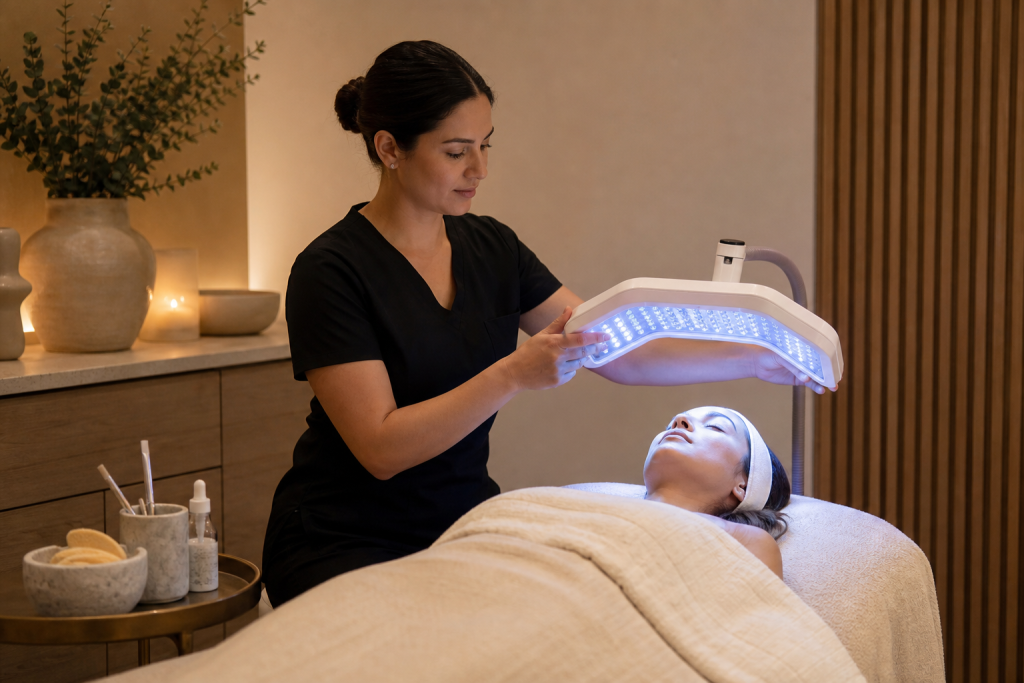
An LED light therapy facial add-on is a short, supervised treatment that uses specific wavelengths of visible or near-infrared light applied after or during a professional facial. It complements cleansing, exfoliation, extractions, hydration, or serums without replacing those core steps. Providers commonly offer red and near-infrared light for signs of aging and healing, plus blue light for acne-prone skin; each wavelength targets cellular processes in different ways [1][2].
Confirmed facts, official announcements, and analysis
- Official announcement: The FDA issued draft PBM device guidance on January 12, 2023; it remains active as of 2026-08-23 [3].
- Independent reporting / research synthesis: Laboratory and clinical studies indicate photobiomodulation affects mitochondrial activity and cellular signaling, which may support skin-repair processes and reduce markers of inflammation in some trials [1][2].
- Analysis: In-studio LED add-ons typically use higher-output devices and clinician oversight versus most consumer home gadgets, which affects treatment time and consistency.
How LED photobiomodulation (PBM) works — the science in plain terms
Photobiomodulation refers to how specific light wavelengths interact with cells’ chromophores—light-absorbing molecules—especially within mitochondria. That interaction can increase cellular energy (ATP) production, influence reactive oxygen species, and alter gene expression linked to repair and inflammation in laboratory settings [1]. Clinical studies report changes in skin texture and some aging markers when red and near-infrared wavelengths are used under controlled conditions [2]. However, outcomes vary by device, dose, and treatment schedule, so results are not guaranteed.
Realistic benefits you can expect from an LED light therapy facial add-on
When booked as an add-on to a professional facial at Asal Skin Lounge in Woodland Hills, LED light therapy is intended to:
- Support post-facial calming and reduce visible redness after extractions (short-term)
- Complement active ingredients and serums by enhancing comfort and potential cellular responsiveness
- Provide a noninvasive, low‑pain option suitable for many skin types
Clinical evidence supports modest improvements in some skin-aging measures and inflammation-related markers under controlled protocols; nevertheless, outcomes depend on wavelength, energy dose, and consistency [1][2].
Limitations and what LED cannot do
LED light therapy is not a substitute for medical treatments for severe acne, infections, or dermatologic disease, and it does not provide instant or dramatic results for deep wrinkles or significant volume loss. Instead, expect incremental improvements over multiple sessions when combined with tailored skincare and professional facial treatments. Claims that LED alone will permanently erase deep lines or replace medical procedures are unsupported.
Common risks, contraindications, and practical safety notes
LED treatments are low-risk for most people, but there are important caveats:
- Photosensitivity or certain medications (including some oral and topical drugs) can raise risk; disclose medications and medical history before treatment.
- Active skin infections, open wounds, or recent procedures (e.g., certain laser resurfacing) may contraindicate LED until healed.
- Eye protection is required for facial treatments; avoid direct retinal exposure to high-intensity LEDs.
These precautions align with device labeling recommendations and professional practice guidance; clinicians should follow manufacturer instructions and current regulatory guidance [3][4].
How a professional LED light therapy facial add-on differs from standalone and at-home options
Comparing options helps clients choose what fits their schedule, budget, and goals. The table below summarizes typical differences.
| Feature | In‑studio LED as an add‑on | Standalone professional LED session | At‑home LED devices |
|---|---|---|---|
| Session length | 5–20 minutes appended to a facial | 20–45 minutes per dedicated appointment | 5–30 minutes per home session |
| Practitioner supervision | Yes — esthetician adjusts timing and placement | Yes — clinician monitors full protocol | No — user controls dose and consistency |
| Output and dosage control | Higher-output clinical devices, calibrated | Professional-grade systems with precise dosing | Variable; many consumer units have lower irradiance |
| Evidence level | Supportive clinical research for combined protocols [1][2] | Stronger evidence when using controlled protocols [1][2] | Limited; depends on device specification and use |
| Cost (estimate) | Low incremental fee to a facial | Higher single-service price | Up‑front purchase cost; ongoing use required |
| Ideal for | Clients seeking recovery, calm, or maintenance | Clients committing to a series for clinical goals | People who can use devices consistently at home |
What to ask your esthetician before adding LED to your facial
- Which wavelengths (colors) will be used, and why? Common choices: blue for acne, red/near‑infrared for calming/age support [2].
- How long will the LED add-on take, and is it included in or added to the standard facial time?
- What device model is used and does it follow manufacturer dosing guidelines and FDA labeling expectations? (Reference: FDA PBM draft guidance) [3].
- Are there any contraindications with my medications or skin conditions?
Typical cost and availability in Woodland Hills
As an add-on, LED light therapy is usually priced modestly relative to standalone treatments. Prices vary by studio and device. At Asal Skin Lounge in Woodland Hills, LED add-ons are offered to complement customized facials and anti‑aging services; availability depends on appointment type and practitioner schedule. Call or book online to confirm current pricing and scheduling.
Frequency and treatment planning
For maintenance and calming after a facial, a single LED add-on session is common. For goals like improving texture or subtle signs of aging, clinicians often recommend a series of sessions spaced across weeks. Evidence-based protocols in the literature typically use repeated sessions to measure meaningful changes [1][2]. These are practice-based estimates, not guarantees.
Choosing between an LED light therapy facial add-on and buying a home device
If you want convenience, an at‑home device could help you keep a routine. However, if you prefer professional oversight, device calibration, and combined facial therapies (extraction, serums, massage), an in‑studio LED light therapy facial add-on often gives better integration and reduces user error. Dermalogica and other professional brands emphasize paired protocols and aftercare to maximize in‑clinic treatment value [4].
What the evidence says (short summary of the literature)
Systematic and mechanistic reviews show that photobiomodulation can alter cellular metabolism and inflammatory signaling in ways that plausibly support skin repair and some aging outcomes [1]. Clinical trials of LED phototherapy report improvements in selected measures such as fine lines, collagen markers, or acne lesion counts under controlled settings, particularly when red and near-infrared light are used [2]. Nevertheless, study methods vary widely, and not all devices or schedules produce the same results. Therefore, clinicians should align device selection and protocols with published evidence and manufacturer guidance [1][2][3].
Practical next steps for Woodland Hills clients
- Decide your goal: immediate calming after a facial, acne management, or long-term texture support.
- Book a consultation or facial at Asal Skin Lounge to discuss whether an LED light therapy facial add-on fits your plan.
- Disclose medications, medical history, and recent procedures so your esthetician can confirm safety and timing.
- Ask about recommended series, expected timeline, and any complementary at-home care.
Summary: Who should consider an LED light therapy facial add-on?
Consider this add-on if you want a low‑pain, short treatment to help calm skin after active steps in a professional facial or to support ongoing maintenance. It is appropriate for many skin types, but not a replacement for medical dermatologic care when needed. Discuss expectations with your esthetician and follow recommended protocols to get the most consistent results.
FAQs
Is LED light therapy safe for sensitive skin?
Generally yes for many people, but you should disclose sensitivity, rosacea, or recent procedures. Your esthetician can adjust intensity or skip the add-on if risk is present.
How many sessions before I might notice a difference?
For calming after a facial, benefits can be immediate. For texture or aging goals, studies and clinical practice often use multiple sessions over several weeks; individual results vary [1][2].
Can LED interfere with topical skincare used during a facial?
LED is often used after serums and masks. Some ingredients make skin more photosensitive, so professionals select compatible products and follow device manufacturer guidance to avoid unwanted reactions [4].
Should I buy an at-home LED device instead of getting an add-on?
At-home devices offer convenience but often have lower output and no practitioner oversight. If you prefer professional calibration and combined treatments, an in-studio LED light therapy facial add-on is a practical choice.
Does the FDA approve LED devices?
The FDA has published draft guidance for PBM devices (January 12, 2023) outlining expectations for premarket submissions and labeling; device classification and clearance depend on manufacturer submissions and FDA review [3]. This is an official agency guidance document as of 2026-08-23.
For a personalized recommendation in Woodland Hills, contact Asal Skin Lounge. Book online or call +1 (747) 746-3818 to schedule a customized facial and ask about adding LED light therapy as part of your treatment plan.
Frequently asked questions
Is LED light therapy safe for sensitive skin?
LED light therapy is generally safe for many people, but sensitivity varies. Disclose any history of photosensitivity, rosacea, or recent skin procedures to your esthetician so they can adjust intensity or delay treatment if necessary.
How many sessions are needed to see results?
Immediate calming may be noticeable after an add-on session. For texture or aging improvements, controlled studies and clinical practice commonly use repeated sessions over several weeks; outcomes vary by device, dose, and individual skin biology [1][2].
Can LED therapy be combined with facial serums and masks?
Yes—LED add-ons are typically used with professional serums and aftercare, but some topical ingredients can increase photosensitivity. A trained esthetician will select compatible products and follow device manufacturer guidance [4].
Should I buy an at-home LED device or get the in-studio add-on?
At-home devices provide convenience but often have lower irradiance and no practitioner oversight. If you want calibrated dosing and combined facial therapies like extraction or professional serums, an in‑studio LED light therapy facial add-on is usually the better choice.
Need practical help?
Asal Skin Lounge — Contact us to schedule service or request a quote. Service area: Woodland Hills.
Topic in context

Sources and further reading
These links were validated and checked when possible when this article was created; some publishers limit automated requests. Facts, guidance, prices, regulations, and availability can change.
- Photobiomodulation: A review of the molecular evidence for low level light therapy — PubMed / NCBI — primary source
- Light Emitting Diode Phototherapy for Skin Aging — PubMed / NCBI — primary source
- Photobiomodulation (PBM) Devices – Premarket Notification [510(k)] Submissions — Draft Guidance for Industry and FDA Staff (issued January 12, 2023) — U.S. Food and Drug Administration (FDA) (2023-01-12) — primary source
- Dermalogica — Pro Skin Treatments (professional treatment guidance & aftercare) — Dermalogica